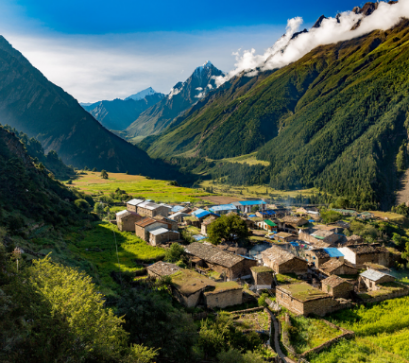
Nepal is celebrated worldwide for its Himalayan peaks, many of which are household names such as Everest and Annapurna. Yet beyond the popular trekking routes lies a host of lesser-known mountains of striking beauty and deep cultural resonance. Among them stands Gauri Sankar, a revered peak in the Rolwaling Himal, close to Nepal’s frontier with Tibet.
Location and Geography
Gauri Sankar rises to 7,134 metres (23,406 ft) in the Dolakha District of Bagmati Province, around 100 kilometres northeast of Kathmandu. It is the second-highest peak in the Rolwaling Himal, surpassed only by Melungtse (7,181 m) on the Tibetan side of the border. On clear days, Gauri Sankar can be seen from the Kathmandu Valley, dominating the skyline with its symmetrical twin summits.

Twin Summits and Symbolism
The mountain is distinguished by its two summits. The northern, higher peak is called Shankar, after the Hindu god Shiva, while the southern peak is known as Gauri, representing Shiva’s consort, Parvati. Together, the name Gauri Sankar symbolises the divine union of the two deities, giving the mountain profound spiritual significance.
Cultural Importance
For centuries, the mountain has been considered sacred. Local communities, strongly influenced by both Hindu and Buddhist traditions, regard it as a powerful natural deity. Because of this reverence, Gauri Sankar was officially closed to climbers until the 1970s. Even today, it is approached with respect, not merely as a physical challenge but as a site of cultural and spiritual meaning.
Mountaineering History
The first successful ascent of Gauri Sankar came relatively late, in 1979, when an American–Nepalese expedition reached the summit via the West Face. Before that, numerous attempts were made but turned back due to the mountain’s steep, technical faces and unpredictable weather. The peak remains a demanding climb, attracting only experienced alpinists seeking a serious challenge away from the more commercialised routes of the central Himalayas.

Trekking and Access
Unlike Everest or Annapurna, Gauri Sankar does not lie on a mainstream trekking route. The mountain is approached through the Rolwaling Valley, a remote and sparsely visited area that offers a rare sense of isolation. The valley’s trails pass through traditional Sherpa and Tamang villages, forests, high passes such as Tashi Lapcha, and stunning views of both Rolwaling and Khumbu peaks. For trekkers, the journey provides not only breathtaking scenery but also an encounter with Himalayan culture in its more authentic form.
Conservation and Environment
The Rolwaling region, including Gauri Sankar, forms part of a fragile alpine ecosystem. Glacial retreat and changing weather patterns linked to climate change are slowly altering the landscape. At the same time, the limited number of visitors has helped preserve its pristine nature. Sustainable tourism could play a key role in balancing economic opportunities for local communities with the protection of this sacred environment.
Gauri Sankar is more than just a mountain; it is a symbol of harmony between natural majesty and spiritual devotion. With its twin summits embodying Shiva and Parvati, its challenging faces attracting skilled climbers, and its remote Rolwaling setting offering peace and wilderness, the mountain stands as one of Nepal’s hidden Himalayan treasures.
PC: Wikimedia Commons - Wikimedia.org
Also Read