In the heart of old Kathmandu, rising above the palaces and courtyards of Kathmandu Durbar Square, stands one of the most sacred and enigmatic temples of the Valley, the Temple of Taleju Bhawani.
For centuries, Taleju has been revered as the royal goddess of the Malla kings, a fierce and protective form of the Divine Mother whose presence shaped the political, spiritual and architectural history of medieval Nepal.
The Origin of Taleju Bhawani
The worship of Taleju in Kathmandu dates back to the 14th century during the reign of King Mahendra Malla (1560-1574), though the cult itself is believed to have earlier roots in South India.
Historical chronicles suggest that the goddess Taleju was brought to the Kathmandu Valley from the south, possibly from the region of present-day Karnataka or Gujarat, where she was worshipped as a form of Durga or Tulja Bhavani. Some legends state that a Malla king received divine instruction in a dream, commanding him to establish her shrine in Kathmandu.
From that point onward, Taleju became the tutelary deity of the Malla dynasty. The king ruled not merely as a monarch, but as a divinely sanctioned representative under her protection. Political authority and divine legitimacy were inseparable.
Taleju as the Royal Goddess
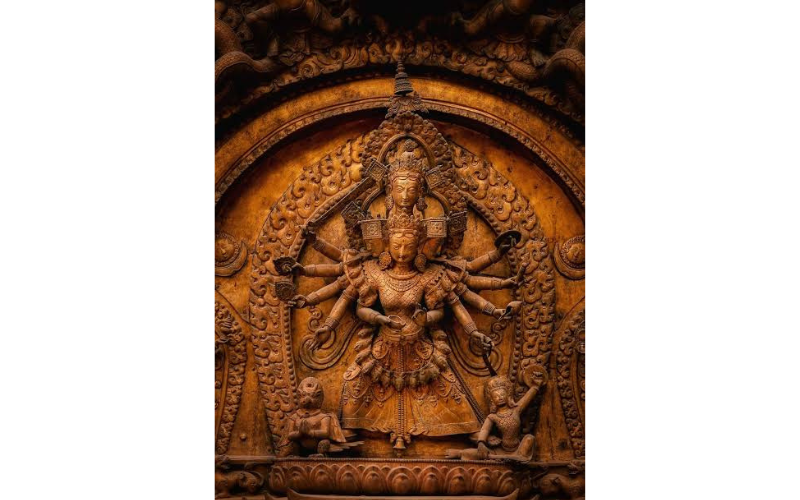
Taleju Bhawani is considered a powerful manifestation of Goddess Durga: fierce, protective and sovereign. Unlike public deities worshipped by all, Taleju was historically reserved for the royal court and select priests.
Her temple is traditionally opened to the general public only once a year during Dashain, the most important Hindu festival in Nepal. During this time, devotees are permitted to enter and offer prayers.
Taleju’s spiritual significance extends further through the living goddess tradition. The Royal Kumari of Kathmandu is believed to embody Taleju herself. The connection between the goddess and the Kumari tradition reinforces the continuity of divine kingship and sacred feminine power within Newar culture.
Architectural Grandeur
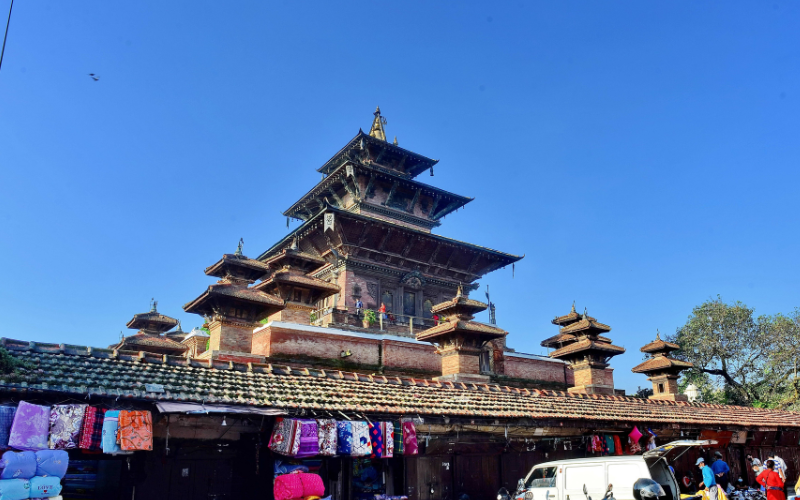
The Taleju Temple, constructed in 1564 by King Mahendra Malla, is one of the tallest and most striking structures in Kathmandu Durbar Square.
Three-Tiered Pagoda Style
Built in the classic Newar pagoda style, the temple rises in three diminishing tiers, crowned by a gilded pinnacle. The multi-roofed structure symbolises cosmic hierarchy: earth, atmosphere and heaven.
The plinth is elevated, accessible by steep stone staircases guarded by intricately carved deities and mythical figures. The raised platform reinforces its exclusivity and sacredness.
Intricate Wood Carvings
The temple is renowned for its exquisite struts and toranas. The carved wooden struts depict various manifestations of the goddess, tantric symbols and protective deities. These carvings are not merely decorative but deeply symbolic, embodying tantric cosmology.
The metalwork including repousse panels and gilded embellishments reflects the exceptional craftsmanship of Newar artisans.
Secluded Courtyard
Unlike many open temples of the Valley, Taleju’s shrine stands within a walled courtyard, reinforcing its royal and esoteric character. This spatial separation underlines its role as a deity of power, accessible historically only to royalty and select priests.
Symbol of Sovereignty and Protection
For centuries, the legitimacy of Kathmandu’s rulers depended upon Taleju’s blessing. It was believed that any king who failed to honour her properly would lose divine favour and, ultimately, his throne.
Thus, the temple is not merely a religious structure; it is a monument to the sacred foundations of Nepali kingship.
Even today, despite Nepal’s transition from monarchy to republic, the temple remains a powerful symbol of the Valley’s cultural memory.
Taleju Bhawani is more than a deity; she is the embodiment of Kathmandu’s royal past, tantric spirituality and artistic excellence. Her temple represents the height of Malla-era architecture and the profound intertwining of faith and governance in Nepal’s history.
To stand before the Taleju Temple is to witness centuries of devotion carved in wood and brick, a reminder that in Kathmandu, the sacred and the sovereign were once one.
Also Read