For many visitors, Nepal’s temples are visually arresting yet culturally opaque. Multi-tiered roofs, intricate woodcarvings, stone guardians and gilded pinnacles form a complex architectural language. Learning how to “read” these structures transforms a sightseeing experience into a deeper understanding of Nepal’s religious philosophy, artistic heritage and urban history.
This guide explains how to interpret Nepali temple architecture with practical examples you can observe on your travels.
Identify the Architectural Style First
Temple architecture in Nepal generally follows three principal forms. Recognising the style is your first interpretative step.

The Pagoda Style
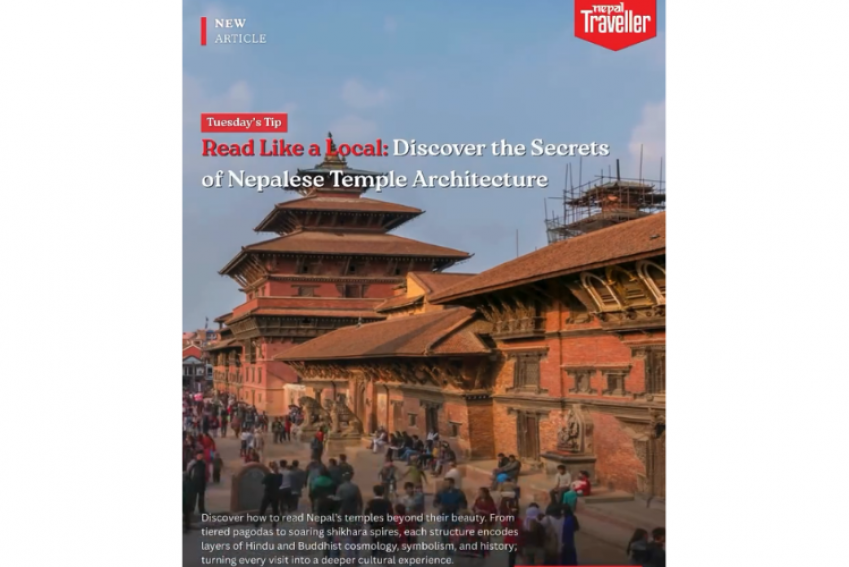
The pagoda is the most iconic Nepali temple form, characterised by tiered, overhanging roofs supported by carved wooden struts.
Key features:
Example:
The five-tiered Nyatapola Temple in Bhaktapur is Nepal’s tallest pagoda temple. Built in 1702, its ascending stairway is flanked by guardian figures guards, elephants, lions, griffins and goddesses, each believed to be ten times more powerful than the one below.
How to read it:
The vertical stacking symbolises ascent from the earthly realm to the divine. The more tiers a temple has, the greater the perceived spiritual significance of the deity within.
Another prominent example is the main shrine of Pashupatinath Temple, dedicated to Lord Shiva. Its gilded roof and silver-plated doors reflect royal patronage and spiritual supremacy.

The Shikhara Style
Unlike the tiered pagoda, the shikhara style features a tall, curvilinear stone tower rising above the sanctum.
Key features:
Example:
The 17th-century Krishna Mandir is Nepal’s most celebrated shikhara temple. Constructed entirely of stone, it rises in a harmonious cluster of spires, each crowned with a finial.
How to read it:
The soaring tower symbolises Mount Meru, the cosmic axis of the universe in Hindu cosmology. The eye is deliberately drawn upwards, reinforcing the idea of spiritual transcendence.

Though architecturally distinct from Hindu temples, stupas are essential to understanding Nepal’s sacred landscape.
Example:
The monumental dome of Boudhanath Stupa represents the universe. The painted eyes on the harmika symbolise the all-seeing wisdom of the Buddha, while the thirteen ascending tiers represent stages towards enlightenment.
Similarly, Swayambhunath Stupa integrates shrines, monasteries and votive chaityas into a sacred hilltop complex.
How to read it:
A stupa is a three-dimensional mandala, a cosmological diagram rendered in architecture.
Examine the Layout and Spatial Hierarchy
Nepali temples are structured according to sacred geometry.
The Garbhagriha (Sanctum)
This inner chamber houses the deity and is often inaccessible to non-Hindus. Its darkness contrasts with the open courtyard, symbolising the mysterious womb of creation.
The Mandapa (Assembly Hall)
A transitional space between the secular and sacred.
Circumambulatory Path
Devotees walk clockwise around the shrine, a practice known as pradakshina.
Example:
In Kathmandu Durbar Square, multiple shrines coexist within a unified sacred courtyard. Their placement reflects ritual significance rather than random urban growth.
Read the Woodcarvings and Struts
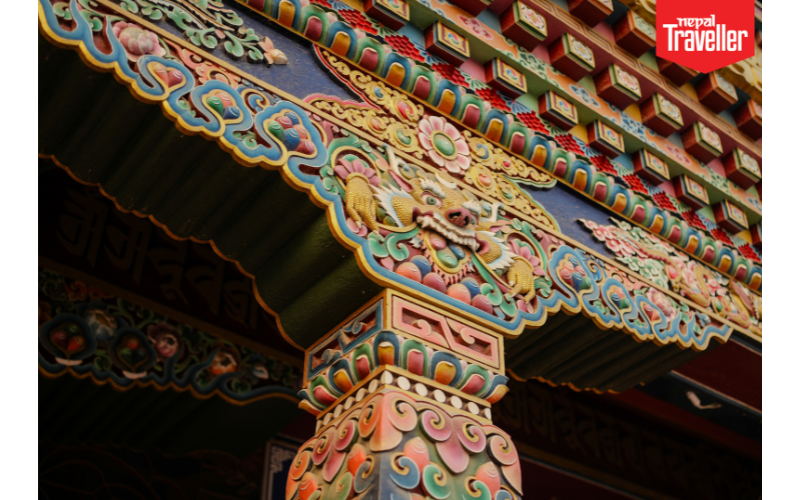
Nepal’s temple struts (tundal) are narrative devices carved in wood.
Deities Motifs
Many struts depict multi-armed Hindu gods in dynamic tantric poses.
Example:
The struts of Changu Narayan Temple display some of the finest early medieval carvings in the valley, including incarnations of Vishnu.
Mythical Creatures
Makara (aquatic beings), kirtimukha (face of glory) and serpents act as protective motifs.
Erotic Imagery
Often misunderstood, these carvings symbolise fertility, cosmic balance and the integration of worldly and spiritual life.
Observe Materials and Craftsmanship
Temple materials reveal both geography and engineering knowledge.
Following the 2015 earthquake, major heritage sites such as Patan Durbar Square underwent meticulous restoration using traditional Newar craftsmanship techniques.
Decode Symbolism in Detail
When visiting temples, look for recurring motifs:
For instance, the large Nandi statue aligned with the sanctum at Pashupatinath establishes a direct devotional axis between devotee and deity.
Understand Height, Power and Urban Context
In traditional Newar town planning, temples were the tallest structures, asserting divine authority over the civic sphere.
In Bhaktapur, Nyatapola rises above residential buildings, visually reinforcing sacred hierarchy within the cityscape.
Practical Cultural Guidance for Visitors
Nepal’s temples are living institutions, not museum artefacts. Visiting them at random offers beauty, but little understanding. To truly appreciate a temple is to read its architecture: every roofline, carving, and spire reflects centuries of history, cosmology, and the intertwined philosophies of Hinduism and Buddhism. Knowing the stories behind what you see transforms a simple visit into a meaningful journey.
PC: Wikimedia Commons
Also Read