Perched atop a hill in the heart of Kathmandu Valley, Swayambhunath Stupa is one of Nepal’s most revered and ancient religious sites. Often referred to as the "Monkey Temple" due to the playful troops of monkeys that inhabit the area, Swayambhunath is a sacred pilgrimage site for both Buddhists and Hindus. With its striking white dome, golden spire, and the all-seeing eyes of the Buddha gazing out in all four directions, this stupa is not only a religious landmark but also a symbol of peace, wisdom, and enlightenment.
History and Legends
Swayambhunath’s history dates back over 2,500 years, making it one of the oldest stupas in Nepal. According to Buddhist mythology, the Kathmandu Valley was once a vast lake. It is believed that Manjushri cut a gorge at Chobhar with his sword, draining the water and revealing a lotus flower. The site where the flower bloomed became Swayambhunath. The name "Swayambhu" means "self-existent", signifying its divine origin.
Historically, King Vṛṣadeva (also known as King Vrishadev) is credited with constructing the stupa in the 5th century CE. Over the centuries, Swayambhunath has been renovated and expanded by various rulers, including King Pratap Malla, who added the long stairway leading up to the stupa in the 17th century.
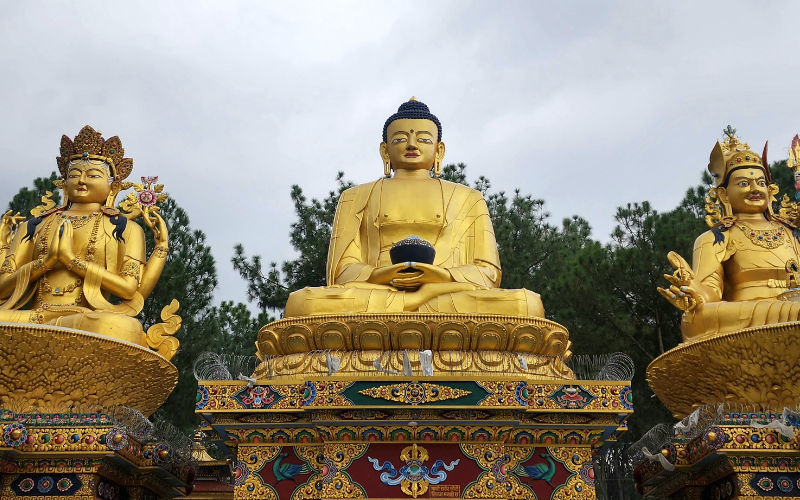
Architectural Significance
The architectural brilliance of Swayambhunath reflects Nepal’s rich artistic heritage. The stupa consists of several key elements:
The White Dome
Representing the world, the large hemispherical dome symbolizes purity and the path to enlightenment.
The Golden Spire
Rising above the dome, the thirteen-tiered spire represents the 13 stages of spiritual enlightenment in Buddhism.
The All-Seeing Eyes
The stupa's most striking feature is the painted eyes of Buddha, symbolizing wisdom and awareness. Between the eyes, a symbol resembling a question mark (१) represents the Nepali number "one," signifying unity and the single path to enlightenment.
The Staircase
The 365-step stone stairway leads devotees and visitors to the stupa, offering a physically challenging but spiritually rewarding ascent.
Prayer Wheels and Shrines
Surrounding the stupa are numerous prayer wheels, statues, and smaller shrines dedicated to Buddhist and Hindu deities. The continuous chanting of prayers and spinning of prayer wheels add to the site’s sacred atmosphere.
Spiritual and Cultural Importance
Swayambhunath holds immense religious significance for both Newar Buddhists (native to Kathmandu Valley) and Tibetan Buddhists. The site is also revered by Hindus, who associate it with Lord Vishnu and other deities.
The stupa serves as a major pilgrimage destination, especially during Buddha Jayanti (the birthday of Lord Buddha) and Losar (Tibetan New Year).
Hindu devotees often visit the nearby Harati Temple, dedicated to the goddess of smallpox and children’s health.
Tibetan monks, local Newar Buddhists, and Hindu sadhus all coexist in this sacred space, showcasing Nepal’s unique religious harmony.

The Resident Monkeys
One of the most entertaining aspects of Swayambhunath is its large population of monkeys. These monkeys are believed to be holy and are associated with an ancient legend: it is said that when Manjushri cleared the valley, his head lice transformed into the monkeys that now inhabit the temple. While they add charm to the site, visitors should be cautious, as these monkeys are known for snatching food and personal belongings!
Visiting Swayambhunath
Swayambhunath is easily accessible from Kathmandu city center and is best visited in the early morning or late afternoon to avoid crowds. Here are some tips for visiting:
Entrance Fee: Foreign visitors must pay a small entry fee, while Nepali citizens and SAARC nationals have discounted rates.
Respect the Traditions: Walk clockwise around the stupa, spin the prayer wheels in the correct direction, and be mindful of religious customs.
Swayambhunath Stupa is more than just a tourist attraction; it is a spiritual beacon, a cultural treasure, and a historical marvel. Whether you are a devotee seeking blessings, a traveler looking for breathtaking views, or a history enthusiast eager to explore Nepal’s ancient heritage, Swayambhunath never fails to captivate the heart and soul. With its mystical aura, deep symbolism, and panoramic views of Kathmandu, it remains an unmissable destination for anyone visiting Nepal.
PC: World History Encyclopedia, Wikimedia Commons, WordPress.org
Also Read