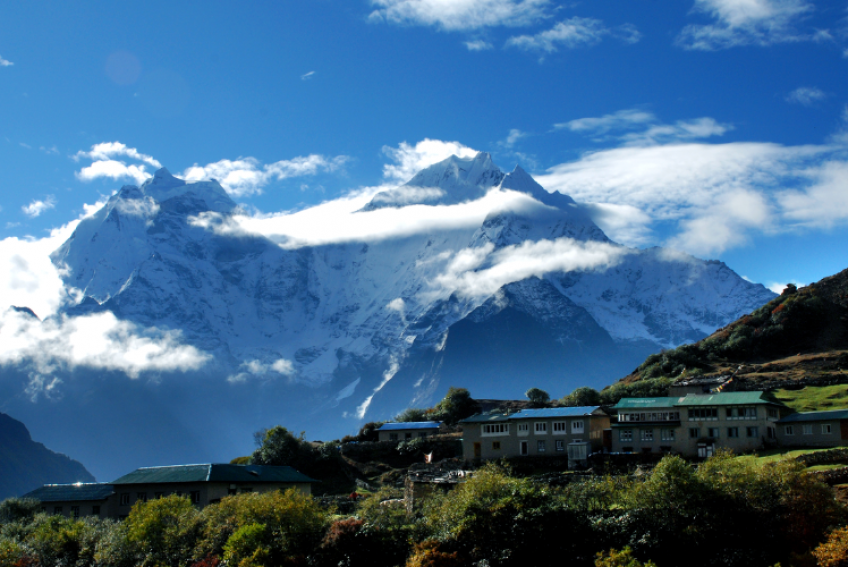
Thamserku, rising to an elevation of approximately 6,623 metres (21,729 ft), is one of the most visually striking mountains in Nepal’s Khumbu region. Although modest in height compared with the eight-thousanders of the Himalayas, Thamserku is admired for its steep faces, elegant ridges and its prominent position along one of the most travelled trekking routes in the country.
Geographical Setting
Thamserku forms part of the Mahalangur Himal, a sub-range of the greater Himalayas. It lies east of Namche Bazaar, the main hub for trekkers heading towards Everest Base Camp, and is connected by a high ridge to the neighbouring peak Kangtega. The mountain stands within Sagarmatha National Park, a protected area recognised as a UNESCO World Heritage Site.
Due to its position near the Dudh Kosi valley and the major trekking trails, Thamserku is often one of the first high Himalayan peaks visible to trekkers entering the upper Khumbu. Its distinctive profile makes it a frequent subject of early photographs taken on the approach to Namche Bazaar.
Climbing History
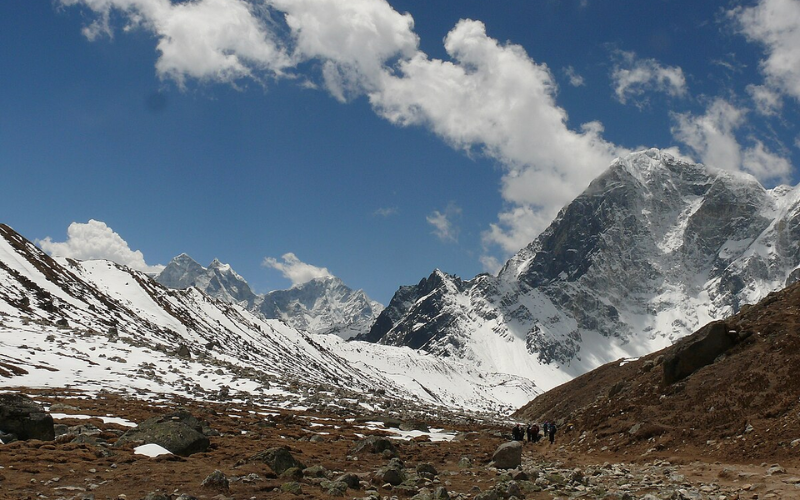
The first ascent of Thamserku was achieved on 4 November 1964 by a team consisting of Lynn Crawford, Pete Farrell, John McKinnon and Richard Stewart. Their climb was part of an expedition associated with Sir Edmund Hillary’s development projects in the region.
The 1964 route approached the mountain from the south-west, climbing a steep couloir to reach the south ridge, which then provided access to the summit. This original route has rarely been repeated, a reflection of its technical difficulty and the complex terrain found on the mountain.
Other faces of Thamserku remained unclimbed until much later. Notably, a Russian team achieved the first ascent of the south-west face in 2014, establishing a demanding new line on the mountain. Despite these successes, Thamserku is still climbed far less frequently than nearby peaks such as Ama Dablam.
Scenic Significance
Thamserku’s dramatic shape and prominent location make it a landmark for trekkers. It is commonly seen from:
trails leading to Namche Bazaar,
points along the route towards Tengboche, and
various villages in the upper Dudh Kosi valley.
Its visibility and striking ridgelines contribute to the memorable Himalayan panoramas of the region.
Natural Environment
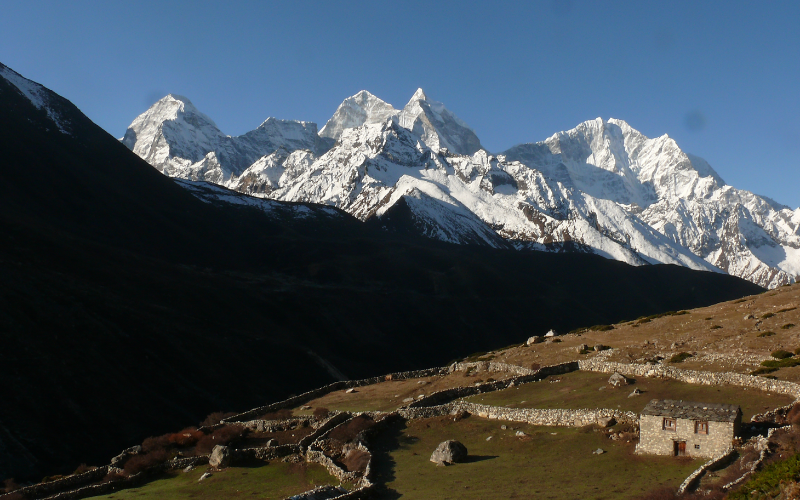
Situated within Sagarmatha National Park, the area around Thamserku forms part of one of the most recognised mountain ecosystems in the world. While specific ecological studies on Thamserku itself are limited, the broader region is known to support species such as Himalayan tahr, musk deer and several alpine birds. The glaciers and high-altitude environments of the Khumbu are also subject to ongoing monitoring due to the effects of climate change.
Thamserku may not be among the highest peaks of the Himalayas, yet it occupies a distinctive place in the geography and mountaineering history of the Khumbu. Its steep faces, beautiful form, and the achievements of the climbers who first reached its summit ensure that it remains an important and respected mountain. For trekkers entering the Everest region, Thamserku often provides an unforgettable first impression of the high Himalaya.
PC: Wikimedia Commons
Also Read