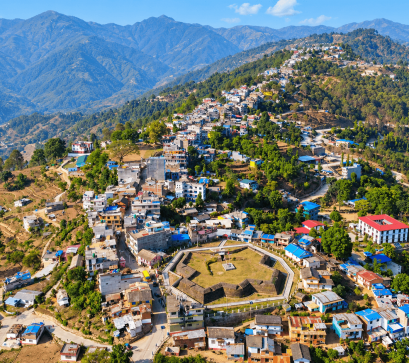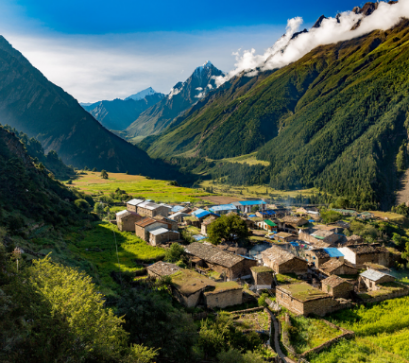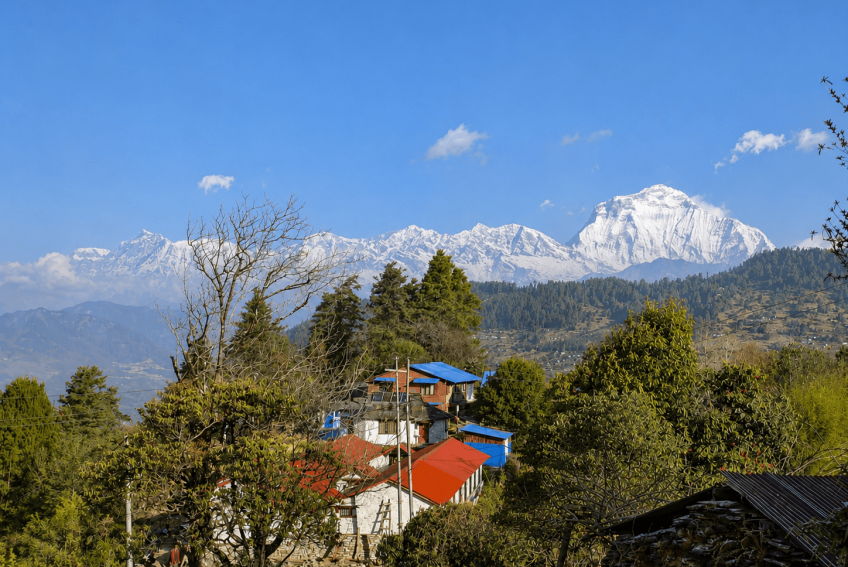
Twenty-nine peaks. That's what you count from the top of Mohare Danda on a clear morning Dhaulagiri I through V, Gurja Peak, Annapurna South, Barah Himal, Nilgiri Himal, Machhapuchhre, Tukuche, three of them over 8,000 metres. It sits in the Myagdi and Parbat districts, a few hundred metres higher than the famous viewpoint at Poon Hill, and most travellers who fly into Pokhara have never heard of it. Nagi Village, the main stop before the final climb, sits at 2,300 metres and gives the trek its other name.
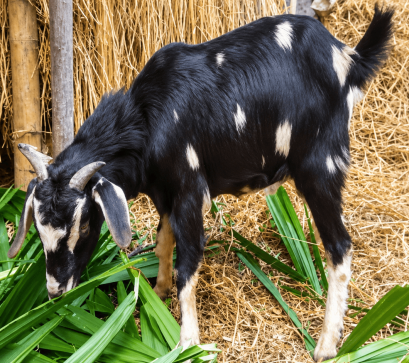
Getting there means walking through what's actually a working landscape, not a trail dressed up for visitors. Oak and rhododendron forest gives way to open ridgelines, then back to terraced fields planted with orange, pear and guava trees. Cattle, sheep and goats graze near the villages Bans Kharka, Suntala Kharka, Lespar, Tilkot, Danda Kharka strung along the route like beads. The land was farmed this way long before anyone thought to build a lodge on it.
The people are Magar and Pun, and their history runs deeper than tourism. Men from these villages have served for generations as Gurkha soldiers in the British and Indian armies, and in Singapore's police force. Stay the night and you might catch the Sorathi dance, a Pun Magar tradition performed for guests.
By day, the villages run on what they've always run on: a cheese operation in Nagi, a small hand-papermaking workshop, organic plots that feed the lodge kitchens. None of it was built for outsiders.
Tourism just found a way to plug into it through Nepal's Micro Enterprise Development Program and UNDP funding, which helped set up the trail and now channels lodge income back into local schools and internet access, first piloted in Nagi.
Plan for four to six days. The usual start is a drive from Pokhara to Nayapul or Galeshwor, then a walk up through Bans Kharka and Lespar to Nagi, the push to Mohare Danda, and a descent through Banthanti or onward to Ghorepani, if Poon Hill is still worth ticking off.
An ACAP permit is required before you set out. Because Mohare Danda connects to several other trails, it's also a natural add-on to a Mardi Himal, Ghandruk or Annapurna Base Camp trip for anyone with extra days.
Come prepared for a swing in temperature mild at the start, sharp and cold on the exposed ridge and don't expect hotel-grade comfort. The lodges and homestays are basic, the meals depend on what the village grew that week, and that's exactly what makes the trip worth taking.