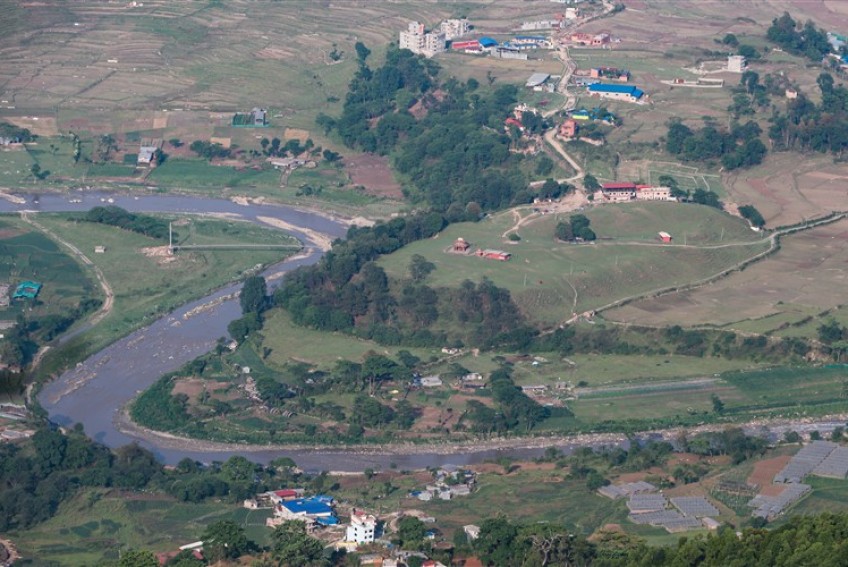
Bungmati is the usual starting point, reached by road from Kathmandu in under an hour. The settlement is one of the valley's older Newar towns, its narrow brick lanes opening into courtyards where wood carving is still a working trade. It is closely tied to the deity Rato Machhindranath, whose temple sits at the heart of the village and who spends part of each year here before the image is moved to Patan. From Bungmati, the trail crosses open farmland toward Khokana, a walk of roughly forty minutes to an hour depending on pace.
Khokana feels older still. Its houses are packed tightly along a single main street, a layout that has kept much of the village's original character intact even as Kathmandu has sprawled around it. Mustard farming has long shaped local life here, and the smell of oil pressing sometimes drifts from the mills in season. The Sikali temple complex on the edge of the settlement is worth the short detour.
From Khokana, the trail turns toward Dakshinkali, gaining and losing height through terraced fields and patches of forest. Walkers pass close to the site of Nepal's first hydropower station, built near Pharping in the early twentieth century and among the earliest of its kind in South Asia, a detail that surprises most people who assume rural electrification came decades later. The final stretch descends into the gorge where Dakshinkali temple sits, its shrine dedicated to the goddess Kali and busiest with pilgrims on Tuesdays and Saturdays.
The full walk takes most travellers between four and six hours at an easy pace, longer with stops for food or photographs. No technical skill is needed, though sturdy shoes help on the muddier stretches during monsoon. Many hikers arrange transport back to Kathmandu from Pharping rather than retracing the route on foot.
What makes this hike worth doing is not elevation or scenery in the postcard sense. It is the chance to move between three sites, two living villages and one active temple, without leaving the valley floor for long. For travellers who have already covered Kathmandu's main squares and want something quieter, this is a solid half-day or full-day option that does not require a guide, a permit, or much planning at all.

.jpg)