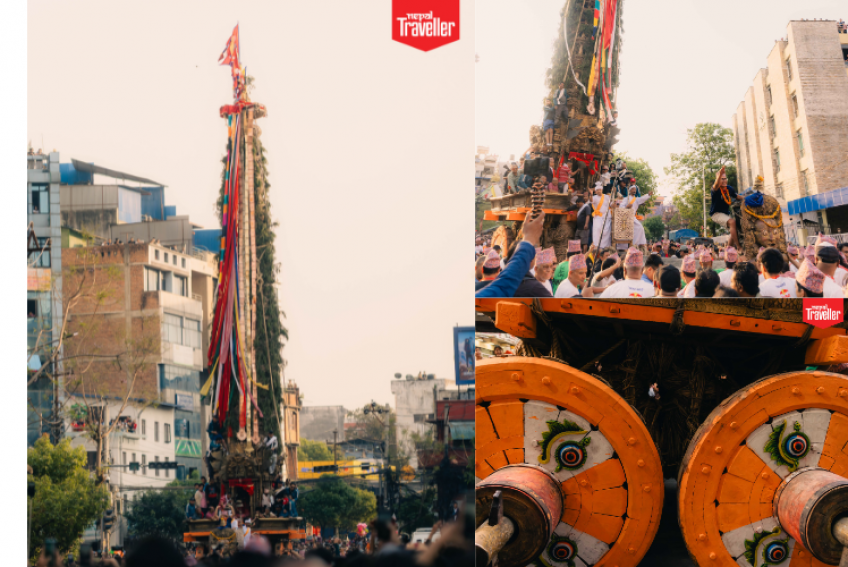
In the ancient city of Patan, for one month each year, a rumbling colossus moves through narrow streets and crowded squares. The chariot of Rato Machhindranath, the revered deity of rain, harvest, and compassion is not simply pulled. It is carried by collective devotion, patience, and ritual precision.
At its base are four massive wooden wheels. To most travellers, they appear as part of an extraordinary engineering feat. But within local belief systems of the Kathmandu Valley, these wheels are far more than structural components; they are seen as spiritually charged protectors, each associated with guardian forces watching over the city.
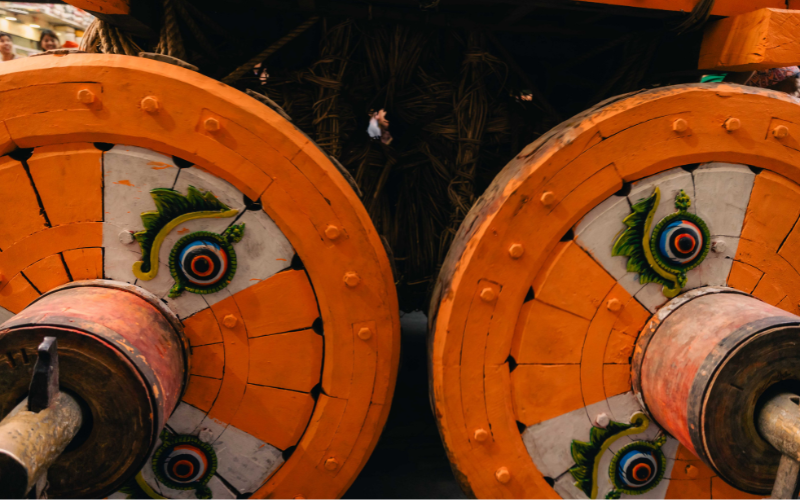
In Newar oral tradition, each wheel is associated with a protective presence often linked to Bhairav: fierce manifestations of Shiva believed to guard space, direction, and energy.
In local interpretation, each wheel of the chariot carries a guardian association linked to Bhairav. The front right wheel is identified with Kundi Bhairav, believed to protect the northern direction, while the front left is associated with Harisiddhi Bhairav, the guardian of the eastern side. The rear right wheel is linked to Lubhu Bhairav, regarded as the warden of the southern territory, and the rear left is connected to Tika Bhairav, seen as the sentinel of the western realm.
Together, they are believed by many locals to form a symbolic protective circle, ensuring safe passage for the chariot as it journeys from Pulchowk to Jawalakhel.
While these associations vary across households and storytellers, they reflect a deeper cultural idea: that movement of the deity through the city is never mechanical but is spiritually governed.
During the festival of Rato Machhindranath Jatra, some priests and devotees believe the wheels are ritually awakened before procession. Through invocation rituals, protective energies are invited to reside within the structure.
Within this worldview, the chariot does not move alone. It is guided, restrained, and protected.
This is why moments of difficulty when a wheel sticks, turns sharply, or resists movement are often met with silence and ritual attention. For many participants, such moments are interpreted not as failure, but as a sign requiring respect, adjustment, or renewed ritual focus.
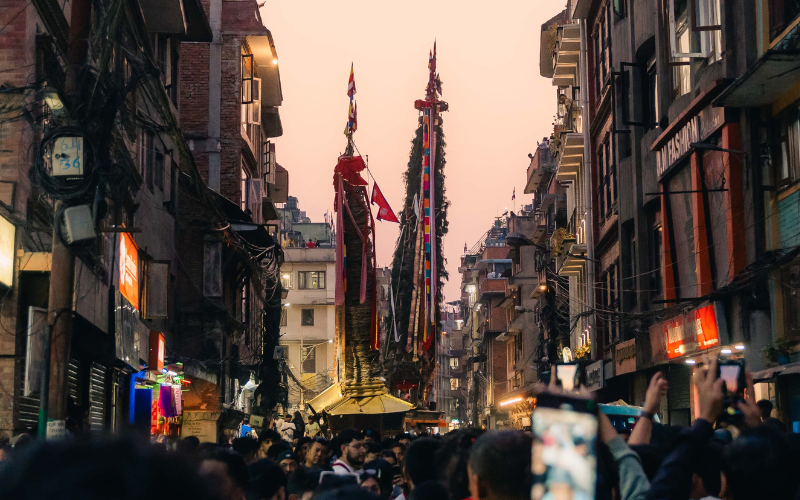
The wheels are traditionally rebuilt and repaired as needed, often using time-honoured Newar woodworking techniques. The craftsmanship is highly specialised, passed through generations of artisan families in the valley.
Dense hardwoods are shaped using mortise-and-tenon joinery without modern nails in many structural points preserving an architectural language that predates modern engineering systems.
This process is not fixed to a strict universal cycle but is guided by ritual calendars, structural necessity, and community consensus, making each reconstruction a living cultural event rather than a scheduled engineering task.
For travellers observing closely during the procession, subtle ritual signs can often be seen:
These gestures reflect a worldview where engineering and devotion are not separate, they are intertwined expressions of respect.
To witness the chariot of Rato Machhindranath is to see a city move in rhythm with faith. The journey is not only about pulling a structure through ancient streets, it is about maintaining balance between human effort, ritual tradition, and collective belief.
The wheels, in this sense, are more than wood and labour. In the eyes of many locals, they are protective presences that travel with the god, not beneath him.
So when you stand in Patan’s squares during the festival, hearing the creak of timber and the chant of crowds, look down at the massive wheels.
They are not just carrying a deity.
They are moving with one.
Also Read