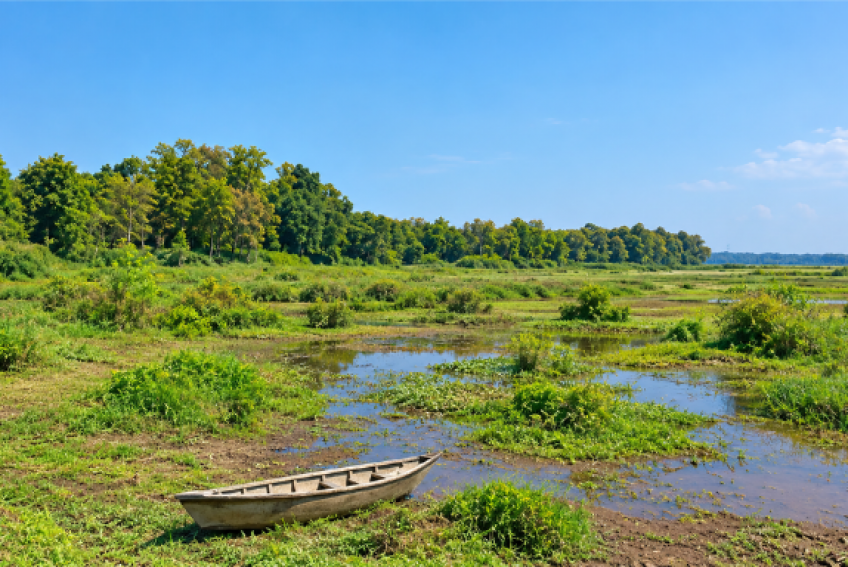
In Nepal's far west, where the Terai flattens toward the Indian border, a golden sea of grass stretches to the horizon. This is the phanta, the open grassland that gives Shuklaphanta National Park its name. In a country famous for its mountains, it is one of the least visited wildlife sanctuaries, and that is exactly what makes it special.
Shuklaphanta covers about 305 square kilometers in Kanchanpur district, Sudurpaschim Province, roughly 750 kilometers from Kathmandu. That remoteness has been its strongest conservation shield. Chitwan welcomes over 200,000 visitors in a good year, while Shuklaphanta sees fewer than 10,000. There are no queues of jeeps here, only wind moving across open ground. Forests, lakes and rivers fill the rest of the park, but the grassland is its heart.
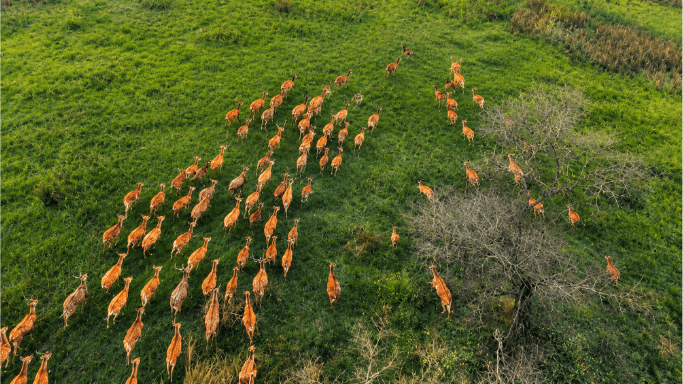
The area began as a royal hunting reserve in 1969 and was later protected as a wildlife reserve to save the dwindling swamp deer, or barasingha. It became a national park in 2017. The effort worked: the main grassland, about 54 square kilometers, now supports more than 2,300 swamp deer, the largest herd on Earth.
At dawn, groups of several hundred graze together, lifting their heads in the cautious rhythm of prey animals. "Chitwan has rhino," one local guide said simply. "We have this."
A transboundary corridor links Shuklaphanta to India's Pilibhit Tiger Reserve, letting tigers, elephants and other large animals move between the two countries. The abundant deer sustain a healthy tiger population, alongside Asian elephants, rhinoceroses and leopards. Tigers are harder to spot on open grassland than in dense jungle, but pugmarks and scratch marks are easy to find.
The skies are just as rich. More than 450 bird species have been recorded, including the critically endangered Bengal florican. Rani Tal and the park's many ponds draw large flocks of migratory birds in winter, and nearby Hirapurphanta protects a growing herd of blackbuck.
The communities on the park's edge are mostly Tharu, who lived with this landscape long before it was protected. Many still bear the costs of conservation, from crop raiding by elephants to livestock lost to predators. Community homestays offer visitors Tharu food and hospitality while keeping tourism income in local hands.
The best season runs from October to April. Winter brings misty mornings and large deer gatherings, while spring offers clearer views as the grass dries. Avoid the monsoon, when floods can submerge the grasslands and cut off roads.
Most travelers fly from Kathmandu to Dhangadhi, about an hour, then drive to Mahendranagar, the nearest town. Jeep safaris, machan viewing towers and birdwatching require a trained guide, and visitors must enter before 3 PM and leave before sunset. Beyond the park, you can visit the Dodhara-Chandani Suspension Bridge or raft the Mahakali River.
Shuklaphanta asks for effort: long journeys, simple lodging and rough roads. In return it offers something rare, a wild place that isn't organized around your presence. As the world's largest swamp deer herd moves across the golden grass, you may be one of very few people watching.
.png)