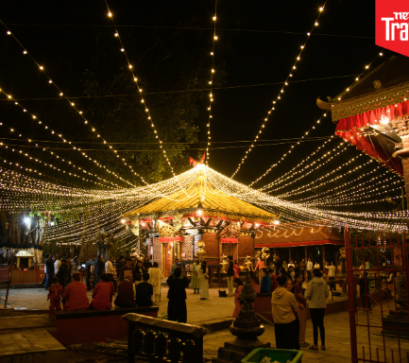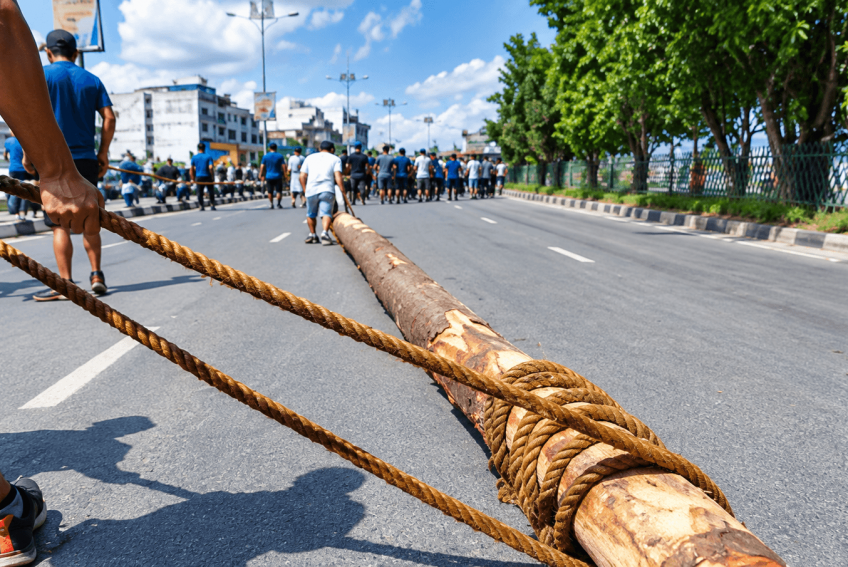
Cut and blessed through age-old rituals, the sacred log made its journey from the forest into the heart of Kathmandu, pulled by hand through the streets as onlookers gathered along the route. This log will soon be raised at Hanuman Dhoka Durbar Square, an act that formally opens the festival. The main spectacle chariot processions carrying the living goddess Kumari alongside Ganesh and Bhairav is set to begin on Friday, September 25, 2026.
Indra Jatra unfolds over eight days and brings together several distinct customs:
The pole itself called Yoh Sim or Yosin in Nepal Bhasa, and Lingo in Nepali carries deep symbolic weight rooted in two intertwined legends.
One story tells of Lord Indra, the king of heaven and god of rain, who came down to the valley disguised as an ordinary man to gather Parijat flowers for his mother, Aditi. Local farmers, unaware they had caught a god, seized him for theft and bound him to a pole in the marketplace as punishment. The raising of the Yoh Sim reenacts that very pole, and the banners hung from it are said to represent the ropes that once held Indra captive.
A second tradition connects the pole to the Indradhwoj, a great victory flag said to have been given to Indra by Lord Vishnu to help the gods triumph over the demons. Raising the pole each year reenacts that cosmic victory and is believed to ward off evil while inviting a good harvest and timely monsoon rains.
The festival's roots stretch back roughly a thousand years. In the 10th century, King Gunakamadeva is credited with formalizing the early pole-raising ceremonies as part of celebrating the founding of Kathmandu itself. Centuries later, in the 18th century, King Pratap Singh Shah added a new layer to the ritual: waving a large, multicolored rainbow flag from atop the pole, a custom that continues to this day.
The journey of the Yoh Sim from forest to city square is treated as a spiritual undertaking rather than a simple logistical task. Government officials, priests, and members of local Guthi (community trust) organizations travel into the Nala forest in Kavre to search for a tall, straight, and unblemished pine tree fit for the honor.
Historically, the selection itself was left to a ritual test: a goat was released into the forest after prayers were offered, and whichever tree it touched first was chosen as sacred. Once identified, the tree is felled, stripped of its bark and branches, and dragged entirely by hand using heavy ropes. Communities pull the log in stages through Kavre, Bhaktapur, and finally into Kathmandu via Bhotahiti and Asan with large crowds turning out to watch and take part along the way.
With the log now inside the city, preparations continue for its formal raising. On the auspicious dawn of Bhadra Shukla Dwadashi, the pole will be ceremonially hoisted a rite known as Yosin Thanegu in front of the Kaal Bhairav statue at Hanuman Dhoka, Basantapur Durbar Square. Once Indra's banner flutters from its top, the eight-day celebration of Indra Jatra will be officially underway, filling Kathmandu's old city with music, masked dancers, and chariots once again.