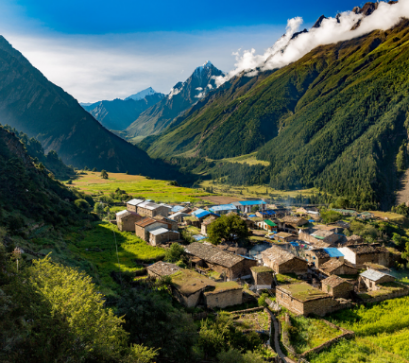
Every afternoon, without exception, the wind arrives. It tears down from the peaks of Nilgiri and Dhaulagiri and barrels through the Kali Gandaki gorge – the deepest river valley on earth – and by mid-morning it is already ripping at the prayer flags on Marpha's hilltop monastery. But the apple trees, planted in careful rows behind low stone walls, stand firm. They have learned to grow here.
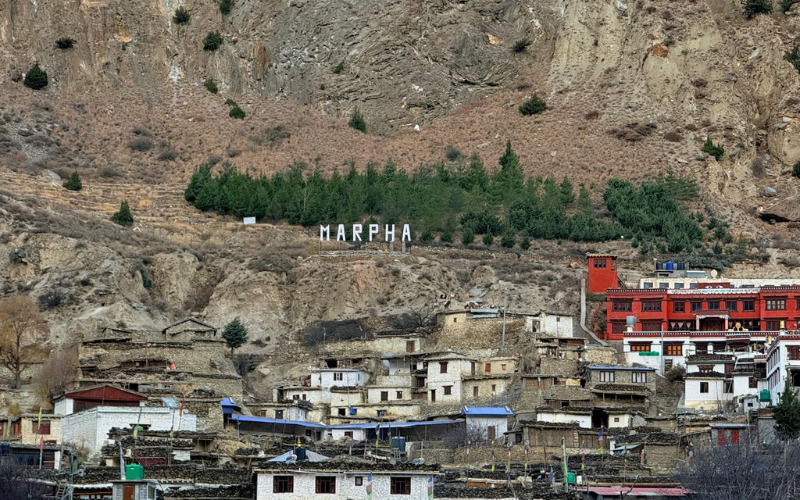
The name Marpha carries its own etymology. In the local Thakali dialect, Mar means hardworking and pha means people. One look at the village – its precisely laid stone streets, its uniformly whitewashed houses, its rooftops stacked with firewood in mathematically even rows – and the name makes immediate sense. This is a community that has always built something out of difficult terrain.
For most of its history, Marpha's economy ran on salt. The Thakali people, the village's dominant ethnic group organised into four main clans – Hirachan, Lalchan, Pannachan, and Jwarchan – were the pre-eminent traders of the trans-Himalayan salt route that ran between Tibet and the plains of Nepal. Salt moved north and south through the Kali Gandaki valley for centuries, and the Thakalis controlled much of it. When that trade diminished after 1959, the village had to find another anchor. It found one in an unlikely crop: the apple.
The story of how apples came to Marpha passes through an airport arrival hall and a royal conversation. King Mahendra, travelling abroad in the early 1960s, encountered Pasang Sherpa of Solu, who was at that time studying viticulture in France. The king, struck by the quality of French apple production and attentive to the development potential of Nepal's remote highlands, encouraged Sherpa to return home and establish apple cultivation in the country's mountain regions.
Sherpa came back and chose Marpha. The semi–arid climate of the Kali Gandaki valley – high altitude, extreme diurnal temperature variation, low humidity, and the valley's natural rain shadow effect – turned out to be nearly ideal for temperate fruit cultivation. In 1966, the Temperate Horticulture Development Center (THDC) was formally established at Marpha, introducing new apple varieties and proven production methods to the region. The farm that began that year is still operating, now under the National Fruit Development Center, and it remains Nepal's primary institution for temperate fruit research, nursery stock, and farmer training in the Himalayan region.
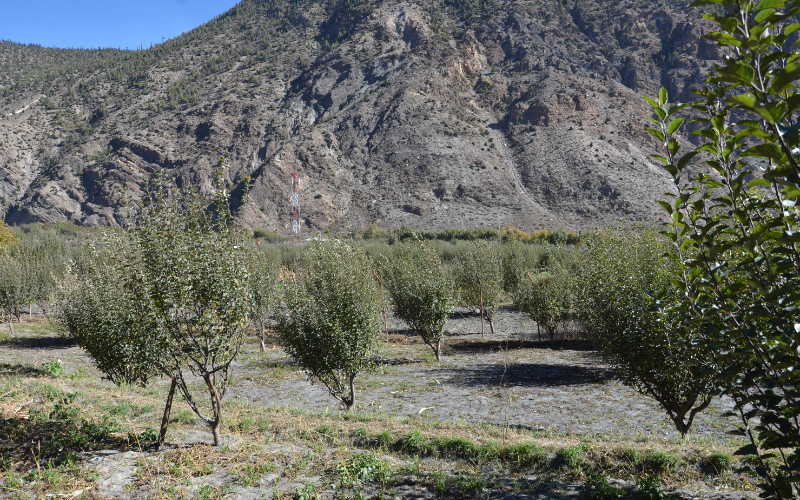
The transformation was not instantaneous, but it was thorough. Within a generation, apple farming had become the economic and cultural backbone of Marpha. Today, nearly every household in the village is engaged in apple cultivation in some form, and the orchards that surround the settlement are as much a part of its identity as its Buddhist monasteries or its stone– flagged lanes.
Walking through Marpha's orchards is a different experience in every season. In spring – April and May – the trees bloom white against the brown desert hills, and the contrast is so sharp it feels almost staged. The Nilgiri massif rises behind them; the Dhaulagiri group closes off the north. The Kali Gandaki runs below, milky with glacial silt. Between the peaks and the river, the orchards are a narrow green strip that looks from above like something a gardener would be embarrassed to claim in such an inhospitable setting.
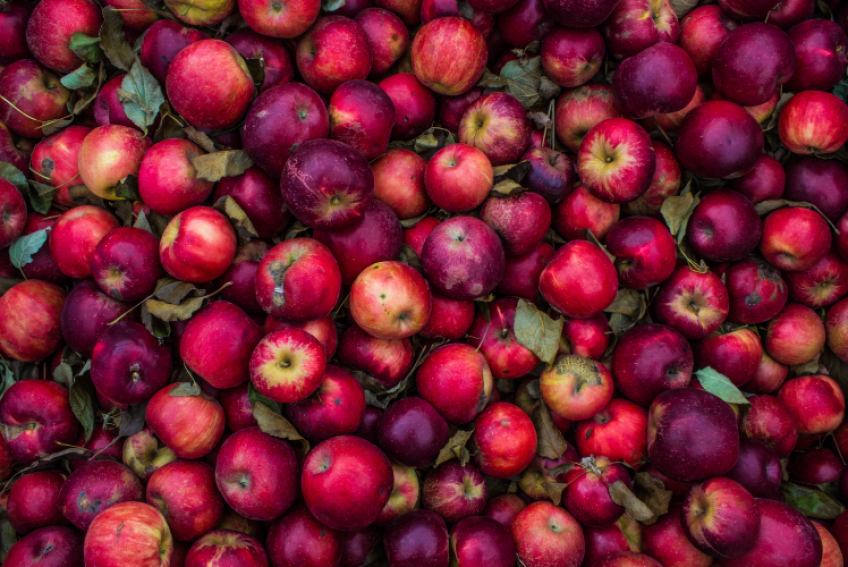
By late summer, the fruit has set and the trees are heavy. The primary varieties grown are Red Delicious and Golden Delicious, the former giving the deep crimson apple that appears in markets across Nepal from Kathmandu to Pokhara, the latter producing the pale, sweet– tart variety preferred in the distilleries. Peach, pear, plum, apricot, walnut, and almond are also cultivated in Marpha and maintained by the THDC, which runs separate demonstration, germplasm, production, and mother plant orchards to support regional farmers.
Harvest comes in September – the single most vivid month in Marpha's calendar. The village smells of ripe fruit; the roadsides fill with crates and baskets; the trails toward Jomsom become intermittently crowded with mules carrying apple loads down toward the main road. Trekkers who time their visit for the harvest find the village at its most generous: fresh apples are offered at nearly every teahouse, and the distilleries are at their most fragrant.
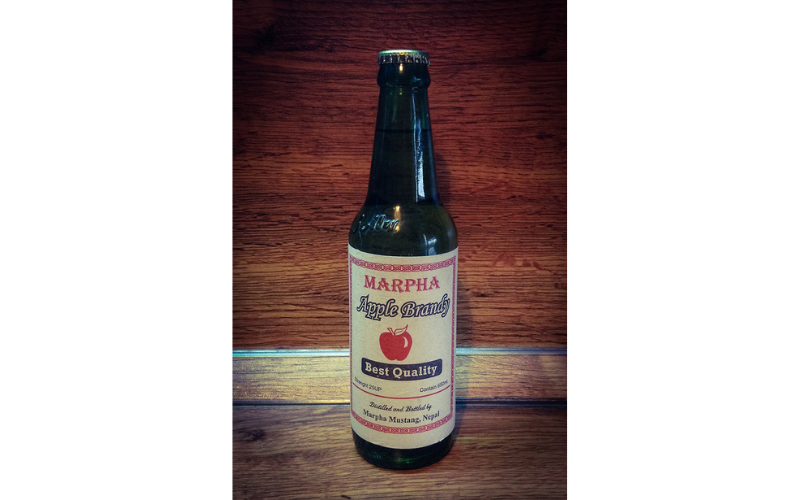
If the apple orchards are Marpha's identity, then apple brandy is its signature. The distilleries of Marpha – there are several operating across the village – produce a spirit that has become one of the most recognized products of the Mustang region, available in Kathmandu and Pokhara supermarkets and carried home by trekkers as a souvenir with genuine local roots.
The brandy is made from apples that do not meet the quality threshold for fresh– market sale – undersized, blemished, or surplus fruit – meaning the distillery tradition emerged partly from practical necessity. The result is a clear, aromatic spirit with more depth than the price point suggests. A warm glass on a cold Marpha evening, after a day on the Annapurna Circuit trail, is one of those experiences that trekkers tend to describe as entirely out of proportion to what it actually is: it is the context, the altitude, and the particular pleasure of something made right where you are sitting.
The THDC also processes surplus fruit into apple cider, apple jam, and dried apples. Plum wine is made from unsold plum harvests; apricot brandy from locally grown apricots. The village has developed, over sixty years of orchard culture, a small but genuine food economy built entirely on the temperate fruit its unlikely landscape produces.
Marpha's apple pies have become so famous among trekkers that the Jomsom Trek is now widely known as "The Apple Pie Trek" – a title earned one warm, flour– dusted teahouse at a time.
There is a joke among experienced trekkers that the Annapurna Circuit has two kinds of person: those who are there for the mountains, and those who are, on some level, there for the apple pie in Marpha. The teahouses of the village produce a version of apple pie that has achieved an almost mythological status on the trail – thick– crusted, cinnamon– scented, filled with the same apples growing on trees outside the window. It is the kind of food that tastes better because of where it is eaten, at altitude, after hours of walking, with the wind audible through the walls.
The Jomsom Trek – the section of the Annapurna Circuit that passes through Marpha – is sometimes referred to simply as "The Apple Pie Trek," a nickname that began among trekkers and has since made its way into guidebooks and travel writing worldwide. It is a modest piece of culinary branding, but it reflects something true about what Marpha offers: not a grand spectacle, but a specific and quietly extraordinary encounter with a place that has made something remarkable out of very little.
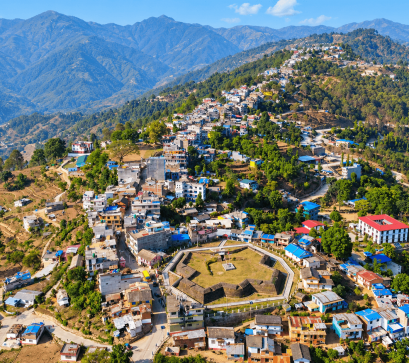
Marpha is not only its apples. The village is a well– preserved example of traditional Thakali architecture – two and three– storey stone houses built without mortar, their flat rooftops lined with carefully stacked firewood. In Marpha, the quantity of wood on your roof is a traditional indicator of family wealth: logs cut by a father and grandfather may remain untouched for decades, a display of prosperity that outlasts the people who placed them there.
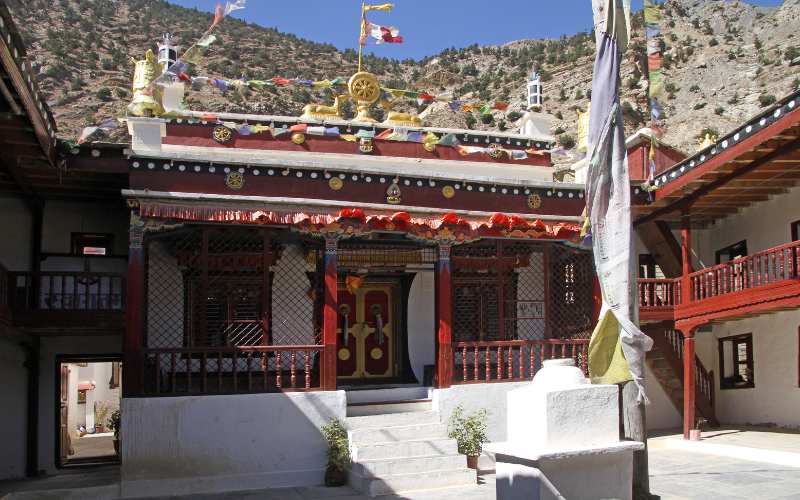
At the village's highest point, the Samten Choling Gompa – a monastery of the Karma– pa Kagyut– pa sect built more than two hundred years ago – overlooks the entire settlement. Its interior holds images of Amitabha, Avalokiteshvara, Vajrapani, and Padmasambhava, along with frescoes of considerable age. In October and November, the monastery hosts Dhekep, a masked dance performed by resident monks. The monastery is open to visitors, and the elevated position provides one of the most complete views of the Kali Gandaki valley available from within the village.
Ekai Kawaguchi, the Japanese monk who passed through Marpha in 1900 on his way to Tibet via Dolpo, stayed for three months in what is now known as Adam Naring's house – studying sacred texts of the Kangyur and Tengyur in the family chapel. The building still stands. Marpha has always been a stopping point on longer journeys; it absorbs travellers and lets them rest.
Available at harvest (September–October). Red Delicious and Golden Delicious are both grown here. Eat one at the source – there is a difference you will notice.
The classic Marpha souvenir. Buy direct from a village distillery for the freshest stock. Several varieties exist; ask for a taste before committing to a bottle.
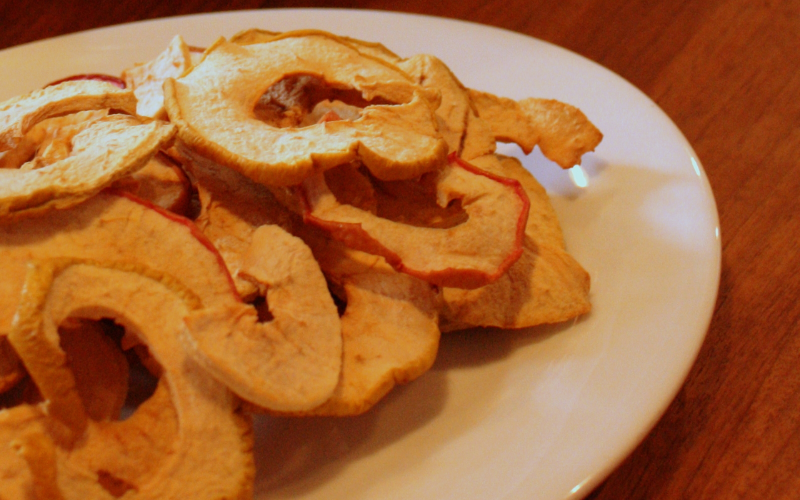
Produced from surplus fruit using German– technology dryers at the THDC. Light, packable, and a genuinely useful trail snack for the remainder of any trek.
Produced by the THDC and some households. Sweet and dense; pairs well with the flatbreads served in most Marpha teahouses.
Lighter than the brandy and more approachable for those who prefer fermented fruit drinks. Best consumed on– site; transportation can be awkward.
A lesser– known but excellent product from the THDC's apricot surplus. More floral than the apple brandy and worth seeking out if available.
Picture Credits: Rohan Manandhar; Wikimedia Commons.