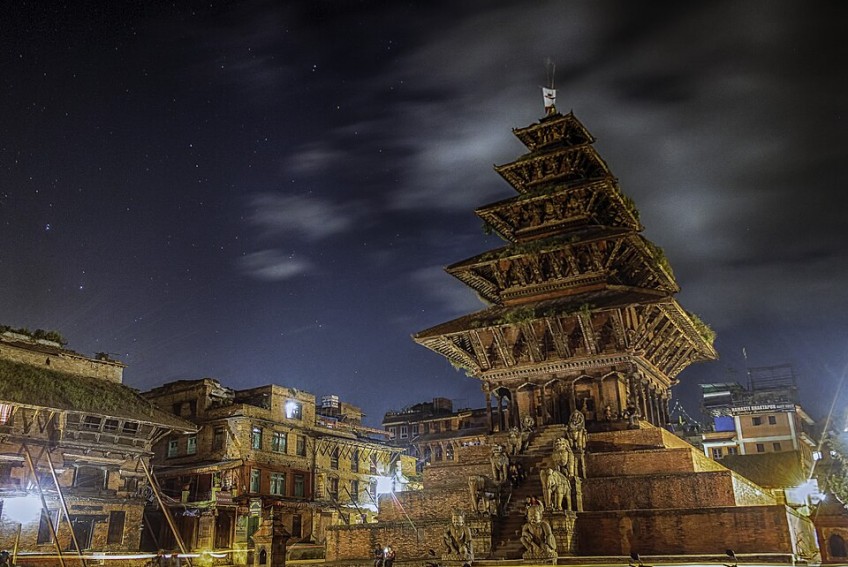
In Nepal Bhasa, "nyata" means five and "pola" refers to a roof or story. Put together, Nyatapola simply describes what it is: a five tiered pagoda. Locals also call it Panch Taale Mandir, which means the same thing in Nepali.
King Bhupatindra Malla commissioned the temple in December 1701, and construction wrapped up by July 1702, roughly six months for a monument of this scale.
Standing at around 30 meters, Nyatapola towers over everything else in Bhaktapur. It remains one of just two five story temples in the entire Kathmandu Valley, the other being the Kumbheshwar Temple in Lalitpur.
The temple is dedicated to Siddhi Lakshmi, a tantric form of Parvati associated with power and protection. Her image inside the inner sanctum is considered so potent that only temple priests are allowed to view it.
According to local stories, the fierce deity Bhairava was causing chaos in the city. King Bhupatindra Malla is said to have built Nyatapola for Siddhi Lakshmi to contain that destructive energy, placing her temple right beside Bhairava's own shrine in the same square.
Climbing to the entrance, you pass five pairs of guardian figures: wrestlers, elephants, lions, griffins, and finally two tantric goddesses. Tradition holds that each pair is ten times stronger than the one below it, growing in power as you near the top.
Nyatapola survived the devastating 1934 earthquake and the 2015 Gorkha earthquake with only minor damage, while many nearby structures in Bhaktapur were destroyed or badly damaged. Its layered, tapering design is often credited with giving it such resilience.
Taumadhi Square is also home to the Bhairavnath Temple, dedicated to the very deity Nyatapola was built to subdue.
During Bisket Jatra, the city's major New Year celebration, Taumadhi Square becomes one of the main gathering points, and Nyatapola forms the backdrop to much of the festivity. Crowds fill the square while chariots and rituals move through the area beneath the temple's towering silhouette.
Historical records, including an old palm leaf manuscript documenting the construction, show that stones, timber, and labor were donated by residents from across Bhaktapur and neighboring towns like Thimi and Banepa. The temple was, in a real sense, built by the people who still live around it.
Nyatapola is more than a photo stop on the way through Bhaktapur. It is a working piece of engineering, mythology, and devotion that has quietly outlasted kings, earthquakes, and centuries of change, and it still shapes how the city gathers, worships, and celebrates today.