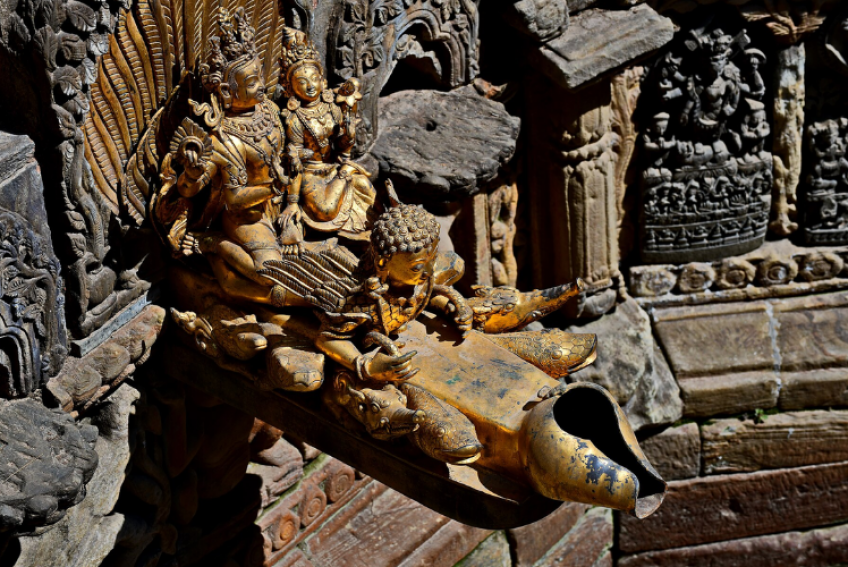
There is a moment, somewhere between the crowds of Kathmandu Durbar Square and the amber quiet of an inner courtyard, when you realize that the art on the wall in front of you is not decorating a building – it is the building's reason for existing. A carved peacock fans its feathers across a latticed window in Bhaktapur. A bronze Tara holds her gesture of compassion in a Patan workshop, still warm from the fire. A thangka scroll, gold-leafed and precise, catches the morning light in a monastery corridor. This is what Nepal's traditional arts look like when they are alive. Which, against all odds, they still are.
The most celebrated of Nepal's visual art forms, the Pauwa and the Thangka, are often spoken of in the same breath – and for good reason. Both are scroll paintings on cotton or silk, both depict deities, mandalas, and sacred narratives, and both demand from their makers a discipline closer to spiritual practice than craft. The distinction is one of lineage: Pauwa is the Newar term, rooted in the Kathmandu Valley's own Hindu-Buddhist traditions; Thangka is the Tibetan rendering of what is, in essence, the same ancient form. Scholars broadly hold that the Nepalese Pauwa tradition is the ancestor – carried northward by artists and missionaries as Buddhism took root in Tibet.
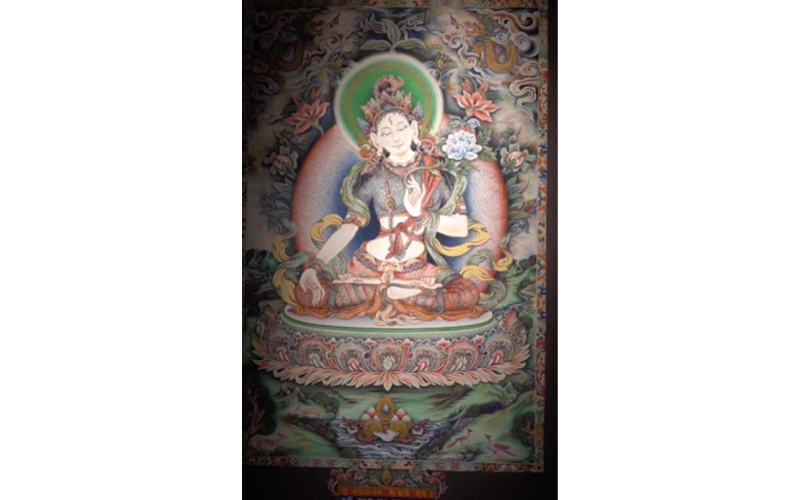
Creating either is a commitment measured not in days but in seasons. Pigments are ground from minerals – lapis lazuli, vermilion, malachite – and bound with animal glue. Gold leaf is applied with a patience that brooks no hurry. Historically, painters entered a period of ritual purification before beginning work, understanding themselves less as creators and more as channels. The finest surviving examples, some dating to the 13th and 14th centuries, can be found in museum collections in Patan and Bhaktapur, though the tradition remains vigorously alive in workshop studios throughout the Kathmandu Valley, where masters still take on apprentices in the old manner, passing technique hand to hand across generations.
A Pauwa is not made for a wall. It is made for a gaze – slow, returning, devotional.
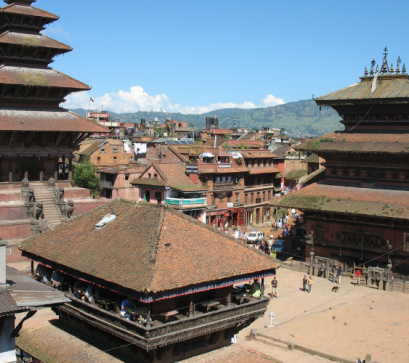
Walk through any of Nepal's historic city cores – Bhaktapur, Patan, the older quarters of Kathmandu – and you are walking through an open-air museum of woodcarving whose curators are the buildings themselves. Strut temples carry carved erotic scenes on their lower tiers, a Tantric device to ward off lightning-bearing goddesses who were, by convention, understood to be modest.
Window lattices – the famed tikijhya, or peacock windows – achieve a lacelike intricacy that no machine has ever convincingly replicated. Every beam end, every pillar bracket, every doorframe bears the mark of a chisel guided by centuries of visual grammar. The primary material is sal wood, supplemented by teak. Newar craftsmen, members of specific artisan castes whose professional identity is inseparable from their artistic one, have held this tradition since at least the 14th century, the horizon beyond which wood's vulnerability to time will not let us see.
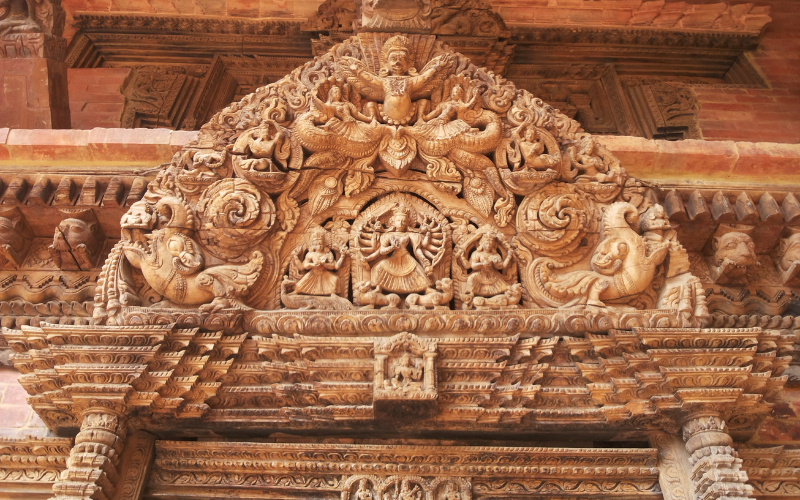
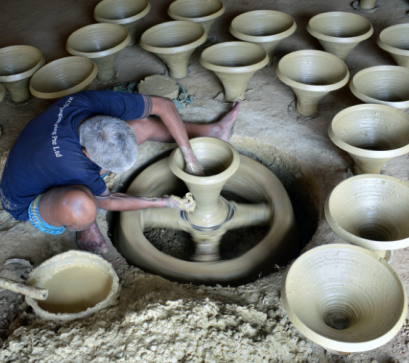
The 2015 earthquake collapsed or damaged some of the finest surviving examples. The painstaking work of reconstruction – using traditional joinery, traditional species, and the hands of surviving masters – is itself a demonstration of the art's resilience. Several workshops in Bhaktapur's pottery and carpenter quarters continue to train young carvers, and regional demand for woodwork in temples and private homes across the hills has kept the practical skills from becoming purely archaeological.
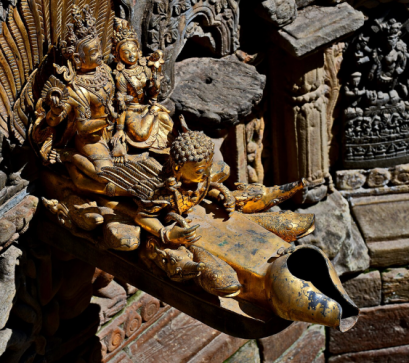
Patan is to metalwork what Bhaktapur is to woodcarving – its undisputed capital, its living archive. The lost-wax casting method, known in Nepal as cire perdue, has been practiced in the Kathmandu Valley for over a millennium. A figure is shaped in wax, coated in clay, fired until the wax runs free, then filled with molten bronze or copper. What emerges from the mould – after filing, chasing, and gilding – is a deity rendered with an authority that centuries of repetition never seem to dull.
Patan's Oku Bahal and the streets around it remain working ateliers where you can watch this process unfold exactly as it did in the Licchavi era, adjusted only for the occasional electric blower at the forge. Nepal's artisan-ambassadors carried this metalworking tradition as far as China: Arniko of Bhaktapur, summoned to the court of Kublai Khan in the 13th century, introduced the pagoda architectural form to China and is still celebrated there as a founding cultural figure.
In the Terai districts of Dhanusha, Siraha, and Saptari – the Mithila heartland – a wholly different artistic tradition has flourished for centuries. Where valley arts are sacred and specialised, Mithila painting is domestic and democratic: women painted the walls and floors of their homes with scenes from Hindu mythology, from nature, from the turning of the agricultural year. The palette is vivid – red, yellow, black, white – and the style is deliberately flat and linear, crowding the picture plane with repeated motifs: fish, lotus, peacock, the marriage of Ram and Sita.
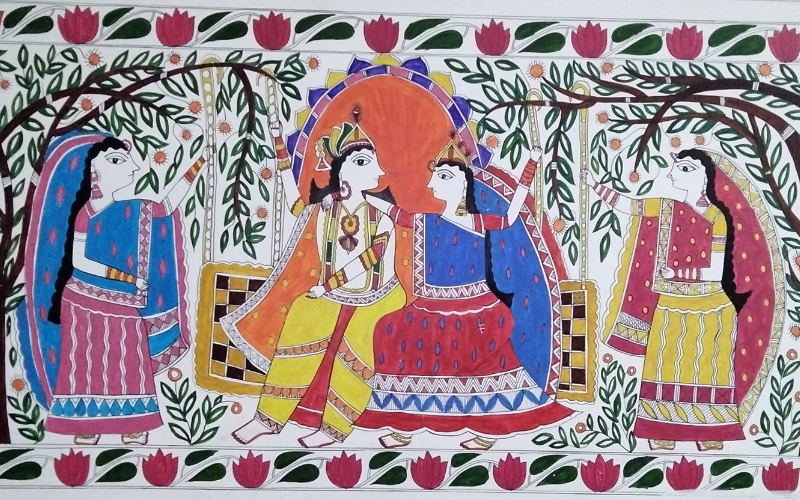
What was once applied to earthen walls in rice paste and natural dye has, over the last half-century, migrated onto paper and canvas, earning international recognition and providing livelihoods to thousands of women artists. UNESCO and various national bodies have worked with local cooperatives to sustain the tradition, though its most vital energy remains in the villages where grandmothers still teach granddaughters, hand to hand, season to season.
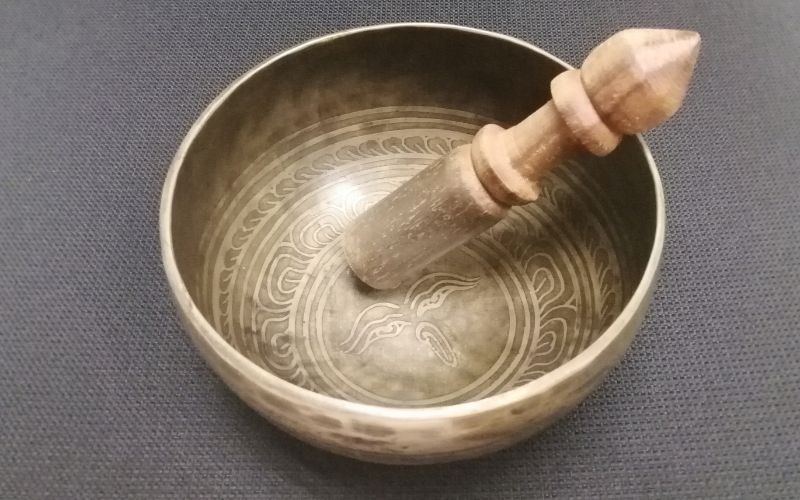
Nepal's traditional arts do not end at painting and carving. The singing bowls cast in and around Kathmandu – struck or rimmed to produce their famous overtone-rich resonance – have moved from monastery ritual into global wellness culture, creating an export economy that also sustains the smithing skills behind them.
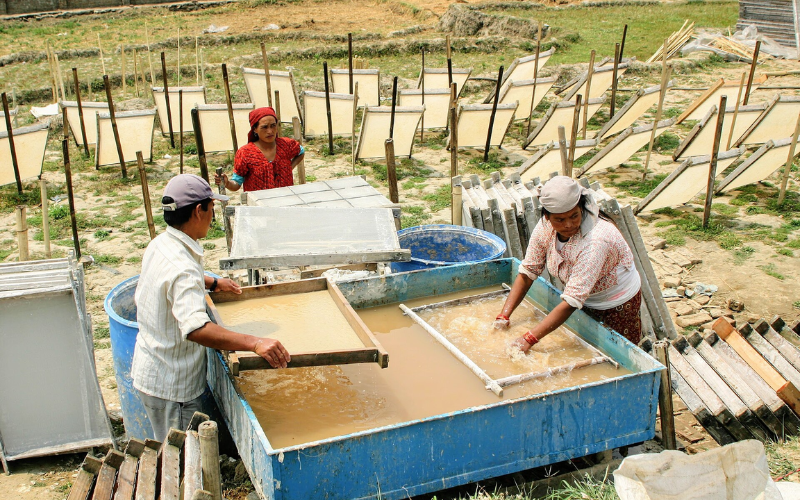
Lokta paper, made from the bark of the daphne shrub that grows wild on Himalayan slopes, has been produced in Nepal for over a thousand years; it remains the material of state documents and high-end stationery, prized for its texture and its insect-resistant qualities. Dhaka weaving, from the hills of Palpa and Terhathum, produces the tightly patterned cloth used in the topi and the dhaka shawl – a fabric whose geometry is as instantly recognizable as a fingerprint. Each of these forms is a node in a larger ecosystem: of caste, of community, of knowledge systems that resist easy digitization.
Nepal did not merely preserve its traditional arts. It continued to use them.
The Federation of Handicraft Associations of Nepal estimates that the craft sector employs more than a million people – artisans, traders, teachers, and the auxiliary workers who supply materials, stretch canvases, prepare metals, and carry goods to market. These are not numbers that describe a dying industry. They describe a sector under pressure, certainly – from cheap imports, from synthetic materials, from young people drawn to urban employment – but one that remains economically and culturally central to Nepal's identity.
What traditional arts need is not nostalgia. They need markets that pay fairly for handmade work; they need documentation of techniques held in the hands of ageing masters; they need schools that treat craft knowledge with the same seriousness as academic learning. Nepal has these arts because it never stopped practicing them. The work of the present generation is to make sure the next one has the same luxury.
Picture Credits: Wikimedia Commons