Most of Nepal's urban festival culture orients itself horizontally. Chariots are pulled through streets. Processions move from one water source to another, from one god-house to a second, the geography of ritual mapped on the same plane as daily life. The body faces outward, the movement is lateral, the city is navigated on foot. Bhaktapur disagrees – or rather, certain of Bhaktapur's festivals make a different demand. They ask participants to go up, to claim the rooftop, to face the sky or the mountain wall to the north, and to conduct their devotions in a plane that separates them from the street-level world below. This vertical orientation is not architectural accident. It is theology made into practice.
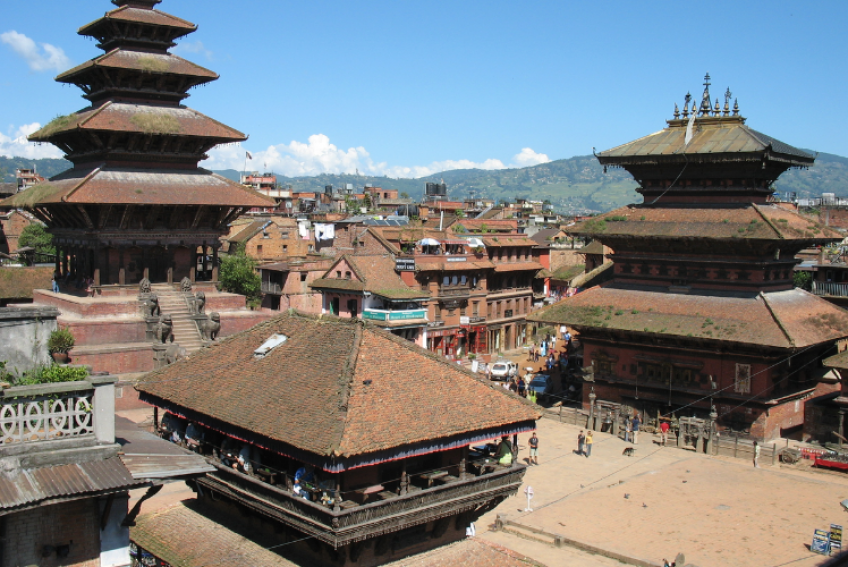
Bhaktapur's traditional urban architecture – the dense, interconnected brick buildings of Taumadhi, Tachupal Tole, and the residential warrens between them – produces roofscapes of unusual continuity. Flat or gently sloped rooftops meet each other at similar levels across entire neighbourhoods, creating an upper city that is functionally accessible.
In older times this roofscape was a working space: grain was dried here, mustard oil pressed, clay tiles stored. The roof was not symbolic elevation. It was a room without walls. The festivals that have claimed this space have done so because the rooftop offers something the street cannot: an unobstructed view of the sky, and in Bhaktapur's specific topographic situation, an unobstructed view northward toward the Himalayan range – particularly toward Changu Narayan hill and, on clear days, toward the peaks beyond.
The most significant of Bhaktapur's festivals is Bisket Jatra, the Newari new year celebrated in Baisakh. While its famous center-piece is the raising and felling of a massive wooden pole – the lingo – and the chariot procession of Bhairava and Bhadrakali through Taumadhi, Bisket also involves rooftop rituals that are less photographed and less legible to outside visitors.
During Bisket, household shrines are opened upward: offerings placed on rooftop terraces rather than ground-level domestic shrines. The logic, as expressed in Newar cosmological thinking, involves the idea that certain divine entities occupy or move through upper registers of space, and that elevated positioning of offerings creates a proximity to those entities that ground-level placement cannot achieve.
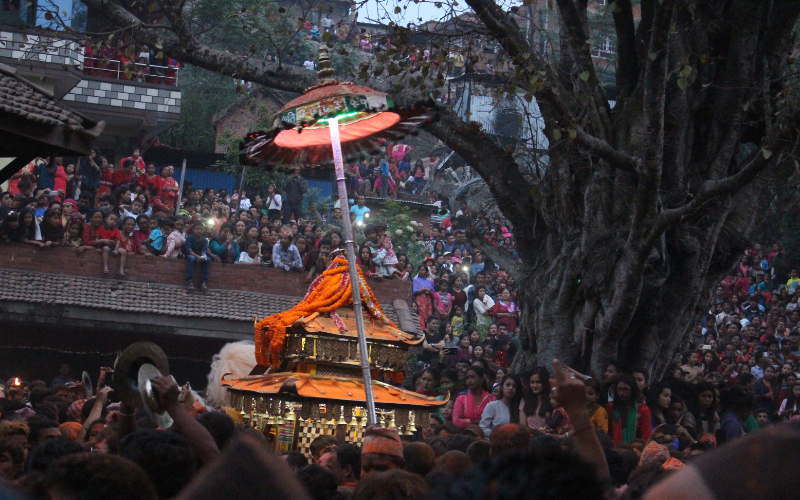
Gatha Mangal – also known in some references as Ghantakarna, though Bhaktapur's celebration has its own specific character – is a festival oriented explicitly against malevolent forces understood to move at ground level and through doorways. The ritual response is vertical.
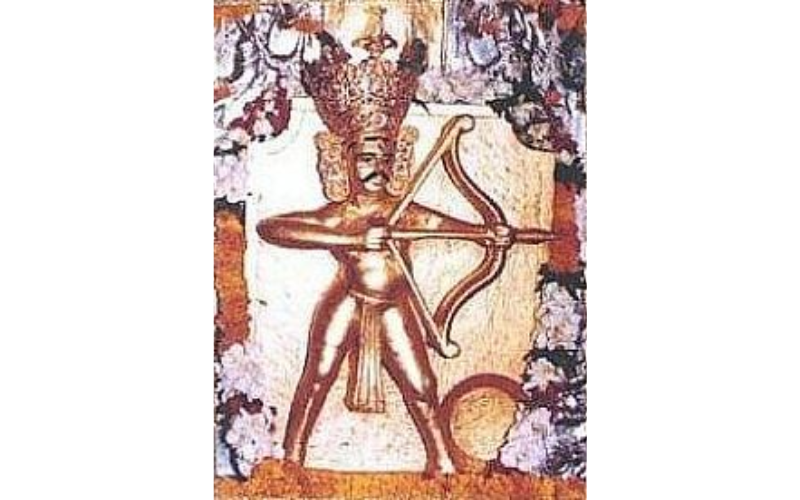
Effigies, iron nails, and protective diagrams are raised on poles above rooftop level, and households conduct protective rituals from their roof edges facing outward and upward. The festival's internal logic is directional: threatening forces are understood to approach horizontally, so the counter-ritual must happen above that plane, addressing the sky as the domain of protective forces. This is not unique to Bhaktapur – variants appear across the Kathmandu Valley – but Bhaktapur's roof-density makes the visual effect of a city conducting ritual from its upper surfaces particularly striking.
Though Indra Jatra is most strongly associated with Kathmandu's Durbar Square, Bhaktapur observes its own version with specific local character. Indra, the deity of rain and sky, is by cosmological definition an upper-register figure – his domain is the atmosphere, the cloud, the monsoon. The festival falls in Bhadra, immediately post-monsoon, at the moment when the harvest prospect is becoming clear.
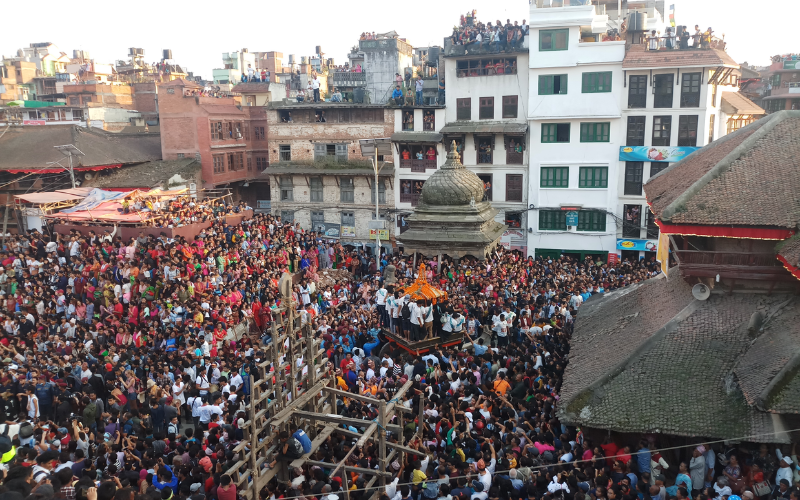
In Bhaktapur, households with Indra devotional lineages conduct particular prayers from roof positions during this festival. The rope-and-pole setup associated with Indra's mythological capture – in which the god came to earth to steal parijat flowers and was caught by a farmer's son – is installed at rooftop height in some traditional households, the rope extending upward rather than into the street.
What runs through all these practices is a cosmological grammar that divides vertical space meaningfully. In Newar religious architecture and thought, the world is stratified: underground waters, earthly domains, and aerial and celestial registers are not metaphorical layers but functional ones. Different entities inhabit each. Ritual must address each on its own terms – which means the practitioner sometimes descends to a river's edge and sometimes ascends to a roof terrace.
The pagoda temple form encodes this thinking architecturally. The tiered roofs of Bhaktapur's temples – rising from a wide base to a smaller peak, each tier slightly steeper than the one below – represent the ascent through cosmological registers. The deity resides at the pinnacle, and the pinnacle is unreachable from the street. Worshippers look up. The rooftop festivals are the closest lay practice can come to that pinnacle: the devotee cannot enter the temple's upper tiers, but can ascend their own building and face the sky from its edge.
Many of these practices are maintained by specific guthi – the Newar social and ritual associations that have governed religious life in the Kathmandu Valley for centuries. In Bhaktapur, guthi culture has proven more resilient than in Kathmandu's more rapidly transformed urban core.
The rooftop festivals are not staged for visitors. They are not announced on tourist calendars or promoted by travel operators. They happen because guthi members fulfil their inherited responsibilities, because households with specific ritual lineages conduct practices their parents and grandparents conducted, because a city built to think vertically continues to do so.
If you are in Bhaktapur during Bisket or Gatha Mangal and you look up at the right moment – toward a rooftop where a family has placed oil lamps at the parapet edge, or where a figure in ceremonial red is facing northward with hands raised – you are seeing something the city has always known how to do. You have simply arrived at the right altitude.