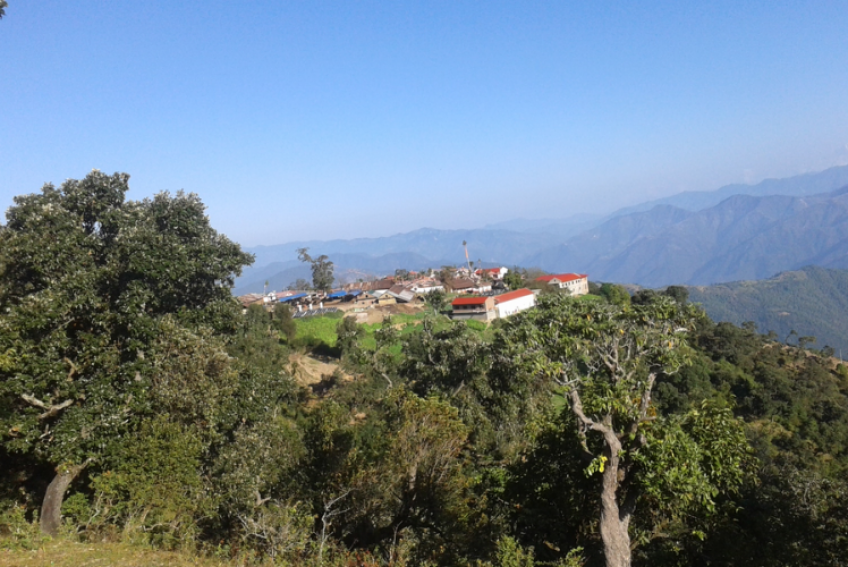
Pyuthan sits in Lumbini Province, flanked by Rolpa to the north and Dang to the west, known to most Nepalis either as a pass-through on the way somewhere else or not at all. And yet, embedded in its northern hills at an elevation where the air carries a certain deliberateness to it, one of Nepal's most revered pilgrimage sites has drawn devotees for over a century – from across the western hills, from the Terai, from India's Hindu heartlands – without ever needing a tourism campaign or an Instagram presence. Swargadwari earns its pilgrims the old-fashioned way: through reputation, through faith, and through the simple fact that arriving there feels, to those who make the effort, exactly like it should.
Swargadwari – स्वर्गद्वारी – translates without remainder: swarga, heaven; dwar, gate or door. The name is not metaphor. For the Hindu devotees who constitute the site's primary community of visitors, this hilltop in Pyuthan is a literal threshold between the mortal world and what lies beyond it.
The Mahabharata tradition holds that the Pandavas, on their final journey, passed through this very landscape ascending toward svarga – and the sacred fire that burns continuously within the temple complex is said to confirm that claim, having been lit, by local account, from a flame discovered underground by the site's founding saint. The National Tourism Board of Nepal has formally listed Swargadwari in its inventory of Cultural and Historic Heritage Sites – an acknowledgement that the site matters beyond its immediate community of devotees.
The fire at Swargadwari has been burning without interruption. Those who tend it do not count the years.
The history of Swargadwari is inseparable from the life of Guru Maharaj Narayan Gautama Khatri, known as Swami Hamsananda – and among devotees simply as Swargadwari Mahaprabhu. He arrived in the hills above Pyuthan in the late 19th century and spent the rest of his life there, organising the care of thousands of cows on the hillside, establishing the Vedic Yagya that would become the site's ritual centrepiece, and attracting a community of followers that has continued to grow in the generations since his passing. He took samadhi in 1940; the place of his burial has since become a meditation spot and object of devotion in its own right. The tradition held that a person of his spiritual stature does not merely die but consciously completes a life's purpose – and Swargadwari, understood as a site of that completion, carries a corresponding weight of sanctity for those who come to pray here.
The Akhanda Yagya Shala – the hall of the unbroken fire sacrifice – keeps the Mahaprabhu's founding ritual alive. The sacred fire burns. Priests conduct pujas through the day. The cows, descendants of the original herd, still graze the surrounding land. What could be a ruin sustained only by institutional inertia is instead a place of genuine, continuing religious life.
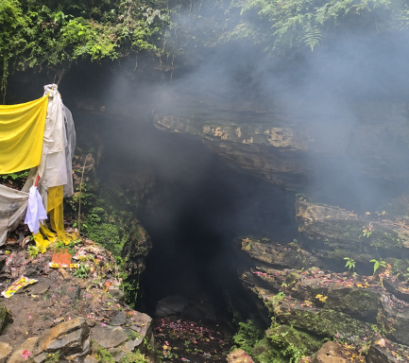
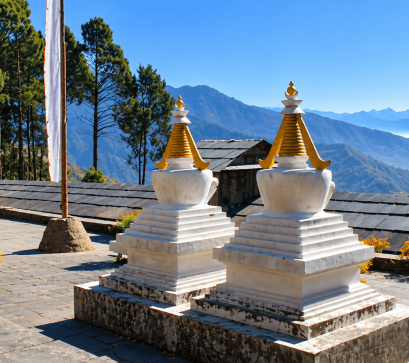
The complex at the summit is compact but layered. The main Swargadwari temple is the focal point of darshan – the sacred sight of the deity – and is surrounded by subsidiary shrines, the Yagya Shala, and a Gufa Mandir built into a natural cave where ritual continues in near-darkness, the air thick with camphor and incense. More than 500 cows roam the grounds, their presence a living embodiment of the site's founding theology: the centrality of the cow in Hindu tradition, and the Mahaprabhu's own vow of service to these animals, is visible everywhere. The government-recognised importance of the site led to the initiation of a cable car project as early as 2009, intended to ease access for elderly and infirm pilgrims; infrastructure development at the site has been gradual but ongoing.
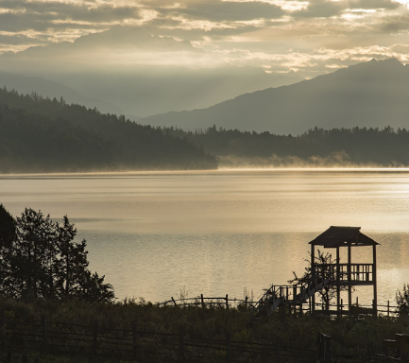
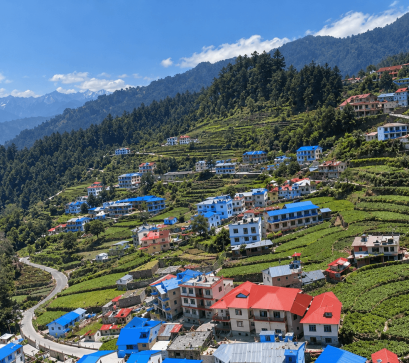
The surrounding landscape delivers its own rewards. From the temple's vantage point at over 2,100 metres, the Dhaulagiri and Annapurna ranges are visible in clear conditions – a panorama that collapses the distance between the spiritual and the geographical sublime. The Dang Valley spreads south and west, its patchwork of fields and forest a reminder that this part of Nepal is as ecologically complex as it is culturally rich. En route, the Jhimruk and Madi valleys offer views that most visitors, absorbed in the purpose of their pilgrimage, receive as grace notes – unexpected, generous, unhurried.
Swargadwari's two great festival moments fall in Baisakh (April–May) and Kartik (October–November), corresponding respectively to Baisakh Purnima and the Laxmi Puja period of Tihar. At these times, the hilltop temple comes alive with melas – the open, celebratory gatherings of pilgrims that are as much social occasions as religious ones. Tens of thousands of devotees arrive from across western Nepal and from northern India, many having walked for days. The atmosphere is festive and fervent simultaneously: vendors selling prasad and religious articles, families camped on the hillside, the sound of bhajan carrying across the ridge. For a visitor not travelling on a fixed pilgrimage itinerary, these periods offer an incomparable encounter with Nepali devotional life in its most exuberant form – though they also require early arrival, basic accommodation expectations, and a tolerance for the beautiful, structured chaos that the Nepali mela tradition produces.
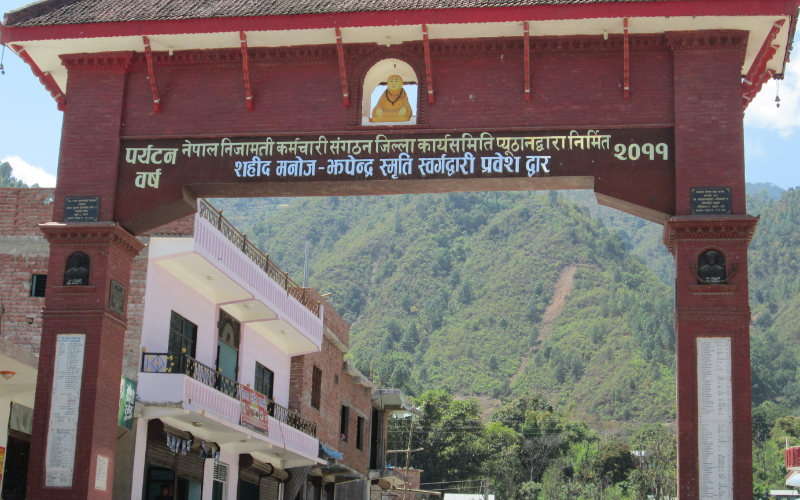
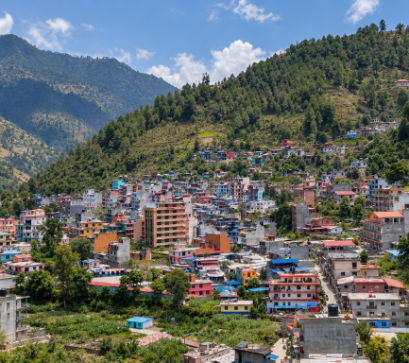
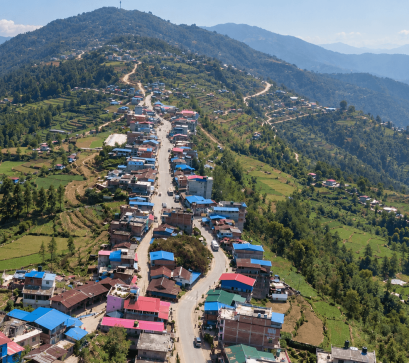
Swargadwari sits approximately 400 kilometres from Kathmandu and is most practically reached via two routes. The more commonly used approach enters from Bhalubang on the Mahendra Highway, heading through Dang (Ghorahi) and then north into the hills – a journey of roughly nine hours by road to the Bhingri base, from which Swargadwari is 13 kilometres further by jeep or on foot. The second route runs through Rolpa, also converging on Bhingri. Both routes require a high-clearance vehicle from Bhingri upward; the road is steep and, during monsoon, demands four-wheel drive. The alternative is to walk: the four-to-five-hour trek from Bhingri is a genuine pilgrimage in the traditional sense, moving through forest and terraced village, arriving at the summit with the particular satisfaction of having earned the view. Nepalgunj serves as the nearest major airstrip for those travelling from Kathmandu by air, with road connections continuing westward from there.
To arrive at Swargadwari is to understand why the walk is part of the prayer.
Bhingri is the practical base for an overnight stay before the ascent, with basic lodges available along the main road. At the summit itself, ashram accommodation is available for pilgrims – simple, communal, and operating on the assumption that visitors have come for the darshan, not the décor. Meals are simple hill fare: dal bhat, seasonal vegetables, chai. The experience is not one of comfort tourism but of purposeful presence, and most of those who make the journey consider the austerity – if it can even be called that – appropriate to where they are.
Picture Credits: Wikimedia Commons