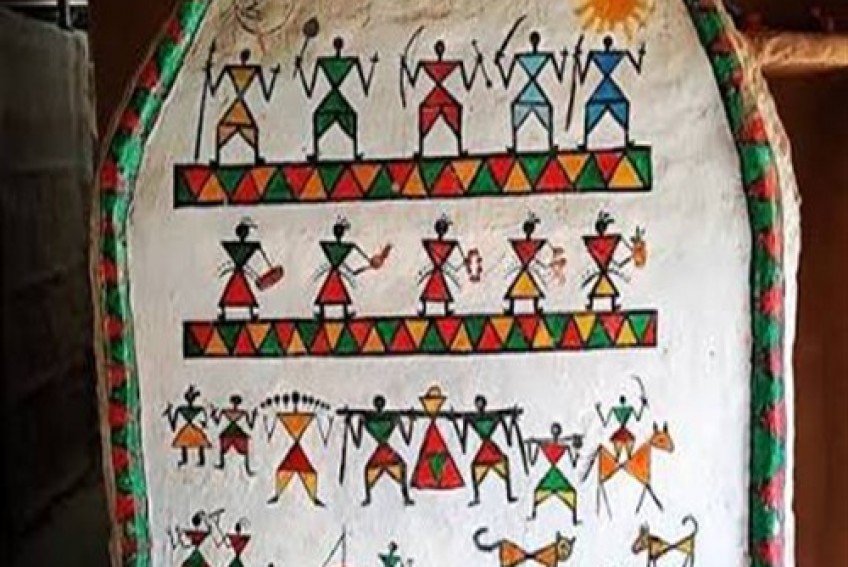
Long before "folk art" became a tourism category, Tharu households across Nepal's Terai were painting their own walls as a matter of course – not decoration for its own sake, but a practice tied to marriage, harvest, and belief. Depending on where you are in the Terai, that tradition goes by two different names: Kohbar in the east, Ashtimki in the west.
In Sunsari, Morang, Jhapa, and Saptari; inside Koshi Province; wall paintings known locally as maukh have decorated mud, bamboo, and thatch homes for generations. In Kanchanpur, a related mural tradition follows village life itself: after a community selects its Badghar (village head), wall painting has historically been part of collective house-building, with neighbors pitching in to construct and repair each other's homes.
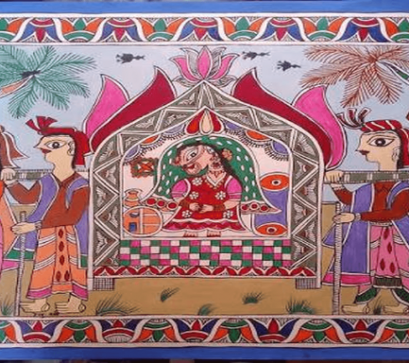
The motifs carry set meanings. Horses represent transport, power, and dynamism. Turtles symbolize longevity and patience. Peacocks stand for beauty and prosperity. Elephants signify power and pride. A bride and groom shown riding in a palanquin represents the importance of marriage and family bonds. Farmers plowing with oxen, fish, spotted deer, tigers, bears, and various deities round out the visual language.
In Banke, Bardiya, Kailali, Kanchanpur, and Surkhet, western Tharu communities paint Ashtimki specifically on Krishna Janmashtami – the eighth day of the waning moon in the month of Bhadra, marking Krishna's birth. The name comes from "Ashtami" (the eighth day) and "tika" (a sacred mark).
Painted inside the home of a village elder, Ashtimki is understood by the community as a depiction of the evolution of life itself, not mere decoration. A kadam tree typically anchors the composition's center, with Krishna shown playing his flute among its branches and monkeys climbing around him – Tharu tradition holds that the kadam is Krishna's favorite tree, and that the monkeys represent the children of Siddhapurush. Elsewhere in the painting, a twelve-headed demon figure represents evil, and a palanquin scene depicts Draupadi, wife of the Pandavas, being carried by two bearers – which some Tharu tellers instead connect to the marriage of Ram and Sita. Artists work with natural pigments: red clay, white stone powder, colored earth, vermillion, and pastes made from flowers and leaves.
The threat to Kohbar and Ashtimki alike isn't cultural indifference – it's construction material. Both traditions depend on mud walls as canvas, and as concrete and brick homes replace thatched houses across the Terai, there's simply less surface suited to the technique. Community leaders in both Kanchanpur and Sunsari describe the practice surviving mostly in remote rural pockets now, passed down in shrinking numbers as fewer households maintain mud construction at all.
Some homestay programs, like the one in Barauli, have begun offering hands-on wall-painting experiences for visitors – a small but genuine way to turn tourism revenue into an incentive for keeping the skill alive, before the last mud walls it depends on disappear for good.
Picture Credits: Wikimedia Commons