
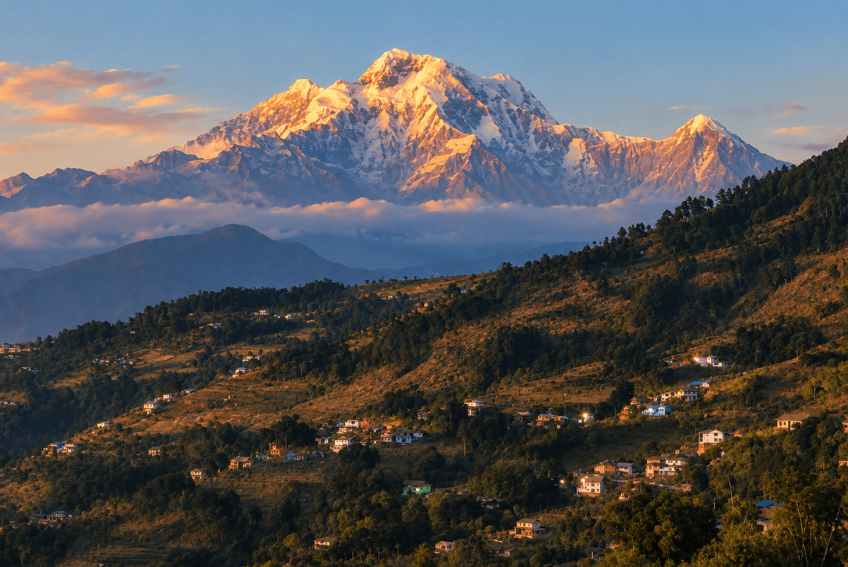
Durlung sits above Kushma Bazaar in Parbat District, Gandaki Province, a market village overshadowed by the district's bigger adventure attractions. It governed itself as a Village Development Committee until 18 May 2014, when it merged with seven neighboring VDCs to form Kushma Municipality, now the district headquarters.
The name comes from Durlungkot, the fortified hilltop settlement that once anchored it: during the Baise-Chaubise period, when Nepal's western hills were split among 22 and 24 small principalities, a local ruler held court on this ridge, before Prithvi Narayan Shah's unification campaign absorbed the region into one kingdom.
The village spans a wide elevation range: households and farmland sit between 1,200 and 1,500 meters, while the Durlung Kot ridge reaches roughly 1,750 to 1,800 meters. That climb is the main draw, a clear-day view across the Annapurna range, Dhaulagiri and Manaslu, with the hills of Baglung, Myagdi, Kaski, Syangja and Gulmi rolling out below. A viewing platform at the Kot takes in the full panorama.
Terraced fields carry the local economy: maize, millet, rice and seasonal vegetables, supplemented by livestock. Farming families still rely on parma, a traditional system of reciprocal labor exchange, to get through planting and harvest. Magar and Brahmin communities were among the first to settle this land, and the 1991 census recorded 3,202 people in 659 households, a mostly Brahmin population alongside Chhetri, Gurung, Magar and Kami families.
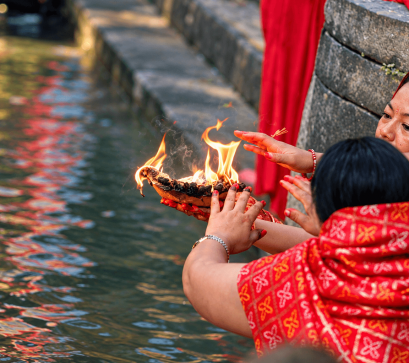
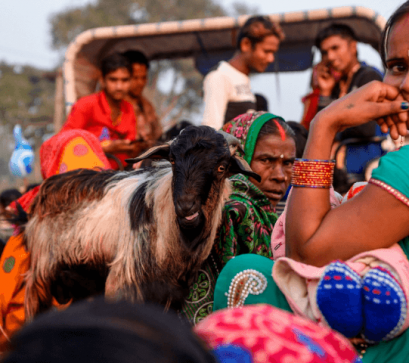
The main religious site is the Durlung Kot temple, dedicated to a local deity worshipped as Durlung ka Bhume Devata. During Dashain, it draws visitors from across the district for rituals that include animal sacrifice, along with offerings of grain, flowers and butter lamps.
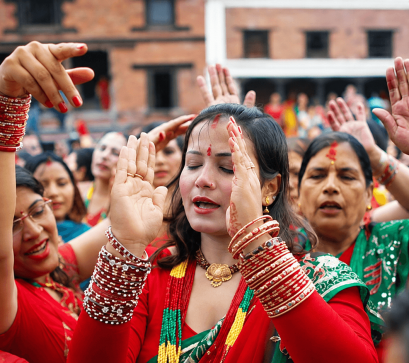
Maghe Sankranti and Tihar are also observed, with Magar communities contributing folk dances and war songs, and Brahmin and Chhetri households centering celebrations on Vedic ritual and storytelling. Stone-paved alleys, mud-plastered walls, carved wooden windows and slate or thatch roofs remain common in the older core, though concrete construction is increasingly replacing them.
Durlung is reached from Kushma Bazaar by a 20- to 60-minute drive via Durlung Chowk, or a 2- to 3-hour uphill hike from Kushma or via Ambot and Chanaute. Chanaute is the base for local homestay initiatives. Kushma lies about 57 kilometers from Pokhara and 12 kilometers from Baglung, making Durlung a realistic day trip or overnight stop for travelers already on that route.
Visitors should expect a village still building out its tourism infrastructure, with homestays limited and mountain views dependent on clear weather, so mornings are the safer bet. Bring hiking shoes, a layer for the ridge wind, and time for the climb; drivers should confirm bus or jeep schedules in Kushma Bazaar first, as services run less often than on the main Pokhara-Baglung highway.

 (1).png)

