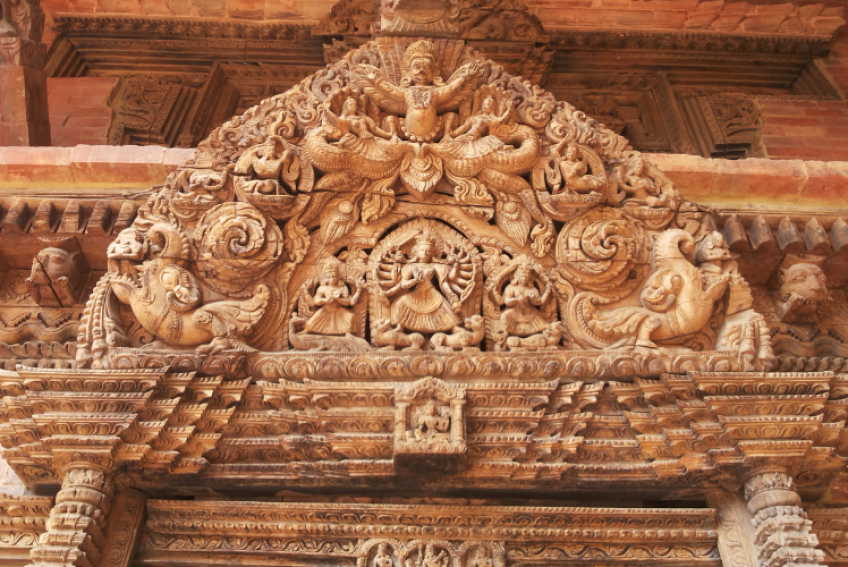
None of these carvings are there for decoration alone. Each animal on a tunala, as these struts are called in Newari, was placed with a specific job in mind, whether guarding a doorway, carrying a god, or marking the line between the everyday world and sacred ground.
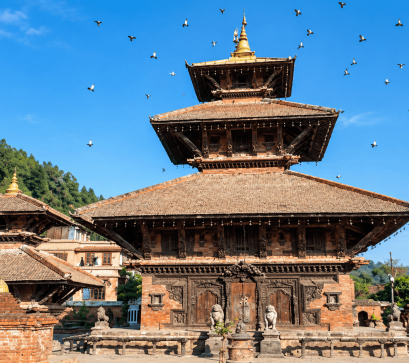
The most visible animals are not on the struts themselves but flanking the temple entrances below them, and they set the tone for what follows overhead. Changu Narayan, widely regarded as Nepal's oldest surviving Hindu temple, has its four gates watched over by paired stone lions, elephants and sarabha, a mythical lion-bodied creature with the added ferocity of a griffin. These pairs are read as protectors, positioned to keep out anything that means the deity inside harm, physical or spiritual.
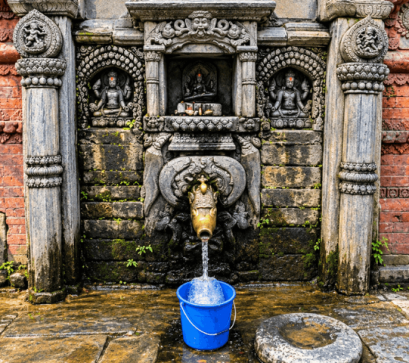
Among the carved creatures, makara shows up constantly at door frames, torana arches and the base of struts. Part crocodile, part fish, part elephant depending on the carving, makara is the vehicle of Ganga, goddess of the sacred river, and of Varuna, who governs cosmic order and the waters. Because it sits so often at doorways, scholars read makara as a boundary marker, the point where a visitor steps out of ordinary life and into consecrated space.
Where makara marks a threshold, Garuda marks a direction. As Vishnu's mount, the half-man, half-eagle figure appears kneeling or in flight near Vaishnav shrines, Changu Narayan included, where a stone Garuda has knelt facing the temple since roughly the fifth century. In Hindu and Buddhist symbolism alike, Garuda stands for rising above illusion, a counterweight to the water-bound makara below.
Naga, the serpent spirits, coil around toranas above doorways alongside makara, believed to guard homes and shrines from misfortune. Smaller carved animals, birds, deer, monkeys, tend to accompany tree deities called yakshi or shalabhanjika on the struts, often as symbols of fertility and abundance rather than protection.
A handful of Malla-era temples, including Patan's South Taleju and Char Narayan, carry a different kind of animal imagery lower down on their struts, showing animals alongside human figures in explicit scenes. No single explanation has held up to scrutiny. Some locals point to an old belief that lightning, imagined as a shy goddess, will not strike a temple carrying such images. Other researchers connect the carvings to Tantric practice, or to a more practical push to encourage repopulation after the wars and plagues of the medieval period. Historians generally agree only that the meaning was never meant to be obvious to casual visitors.
Next time a strut catches your eye in Patan, Bhaktapur, or Kathmandu Durbar Square, it is worth pausing on the animals in particular. They are rarely filler. Each one was carved to say something the builders wanted remembered.