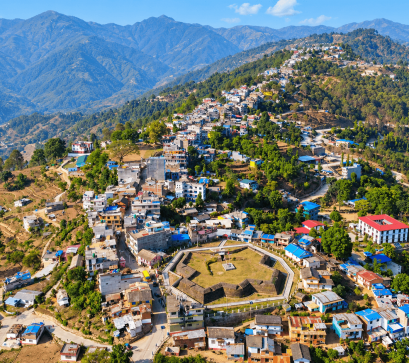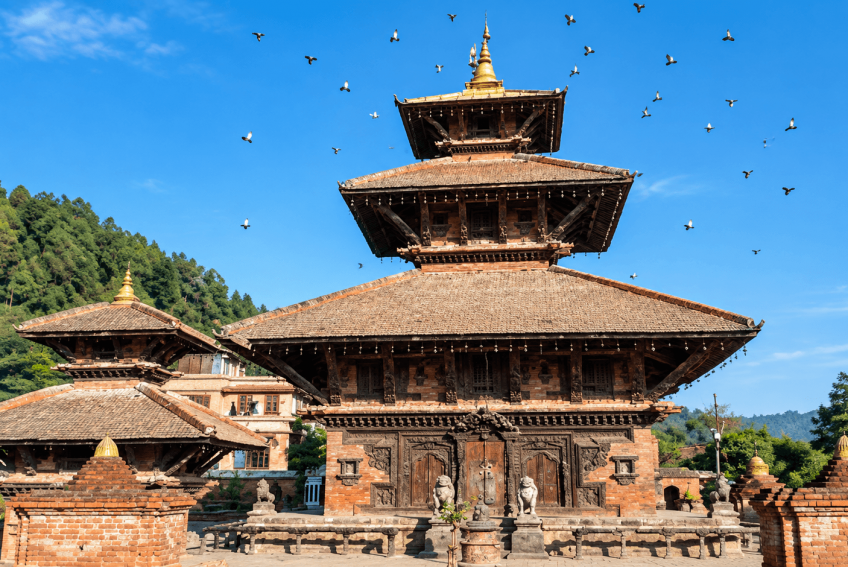
Panauti lies off the main east-west highway that crosses Nepal, so it draws far fewer visitors than Kathmandu Valley's better-known sites, despite being one of the country's oldest towns. The temple, dedicated to Shiva, sits at Indreshwar Temple Square in Panauti, Bagmati Province, at the point where the Roshi and Punyamati rivers meet.
According to the Gopalrajvansavali chronicle, Princess Viramadevi (also recorded as Birmadevi) of Panauti commissioned the temple's construction in 1294 CE, and it took nearly nine decades to complete; the golden pinnacle, or gajur, was donated by King Jayasingh Ramvardhan in 1383.
Scholars disagree on how much of the present structure actually dates to that period. The historian Dowman notes that the Newar Chronicle places the temple's founding firmly in 1294, but is more cautious about the building itself, suggesting the 16th century for most of it, while agreeing the roof struts look older. The scholar Slusser, by contrast, treats the struts as genuine 13th-century originals.
Records show a further renovation in 1816, when King Surendra Bikram Shah donated a new gold-plated copper roof, and a more recent restoration from 1992 to 1996, sponsored by the French government's Kavre Integrated Project, which replaced rotted wood elements and is thought to have helped the temple survive the 2015 Gorkha earthquake.
The temple's roof struts are carved with different subjects on each side: the Matrikas, or mother goddesses, to the north; Salabhanjikas to the east; scenes from the Mahabharata to the south; and the Ramayana to the west.
The roof itself combines small terracotta jhingati tiles with hand-beaten copper on the upper tiers. Inside, two sets of nested brick walls form an ambulatory space not visible from outside, encircling a central Shivalingam that is off-limits to photography and only viewable during the Makar Mela festival, held once every twelve years.
The temple complex includes several smaller structures: the Unmatta Bhairav temple, a recently restored Newar-style Shiva temple to the northwest, a statue of the bull Nandi facing the main temple, and shrines to Vishnu.
East of the temple walls are the Tribeni Ghats, used for cremation rites, along with the Tribeni Ghat Sattal resthouse and the Krishna Narayan and Brahmayani temples. The adjoining Panauti Museum holds brassware, woodcarvings, and other examples of Newari craftsmanship, for which the town is regarded as one of the best-preserved centers in Nepal.
Panauti is roughly an hour's drive east of Kathmandu via Banepa. The temple courtyard and grounds are open daily from 5:00 a.m. to 9:00 p.m.; the museum keeps separate hours, 7:00 a.m. to 6:30 p.m. Foreign nationals pay NPR 300, which covers both the temple complex and the museum.
Visitors should remove their shoes at the entrance, note that non-Hindus are not permitted into the inner sanctum, avoid touching the wood carvings, and be respectful at the riverside ghats if cremation rites are underway.