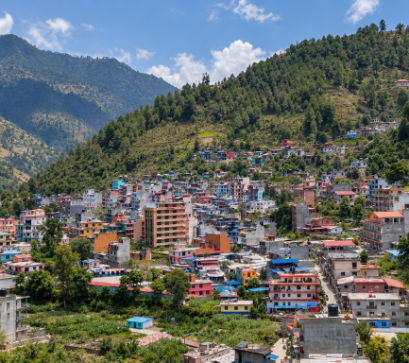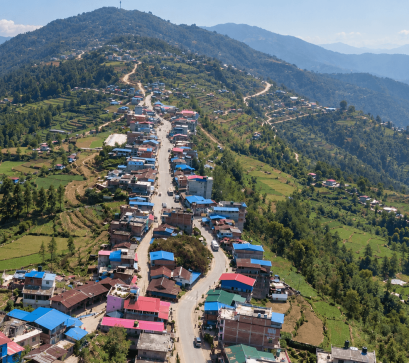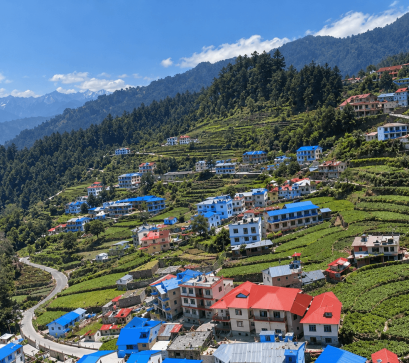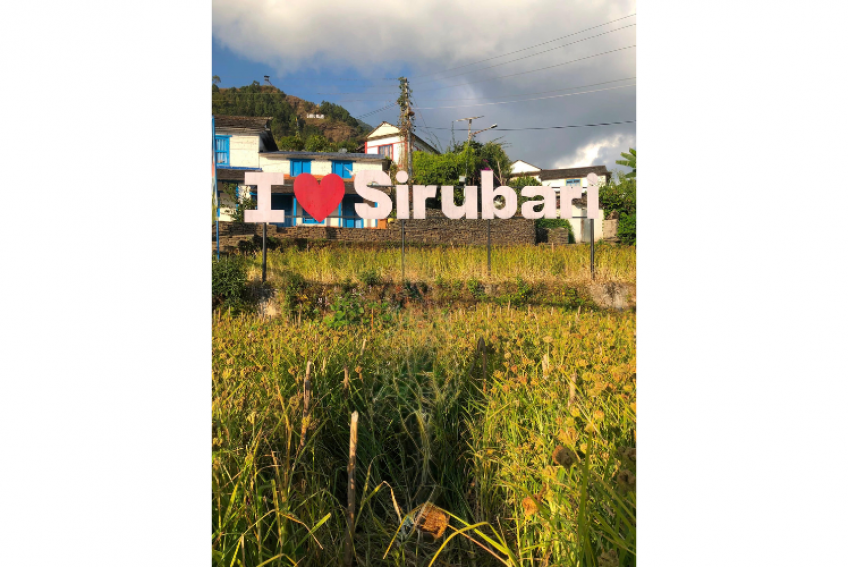
There is a particular kind of quiet that settles over Sirubari in the evening, once the panchai baja drums that greet arriving guests have gone silent and the terraced fields below the village fade into blue shadow. It's easy to forget, sitting there, that this stone-paved Gurung settlement in Syangja district, population barely a few hundred, is where Nepal's entire homestay movement started.
In 1997, a retired Indian Army captain named Rudra Man Gurung decided his village should host outsiders in its own kitchens and bedrooms rather than build a guesthouse for them. Within three years, Sirubari was formally declared Nepal's first model tourism village. Not long after that, it picked up the Pacific Asia Travel Association's Gold Award for Heritage and Culture – a fairly serious honour for a village most maps still don't bother to label.
Sirubari sits at roughly 1,600–1,700 metres on a south-facing hillside in Syangja district, Gandaki Province. Depending on which route you take out of Pokhara, via Naudanda, Arjunchaupari, or Karkineta – the drive covers anywhere from about 35 to 65 kilometres, so it's worth confirming the road your operator is actually using rather than assuming a fixed distance. What the altitude guarantees, regardless of route, is crisp mornings and clear views of the Annapurna, Dhaulagiri, Machhapuchhre, and Lamjung Himal ranges, while staying low enough that terraced rice and millet fields still ring the village and altitude sickness is never a concern.
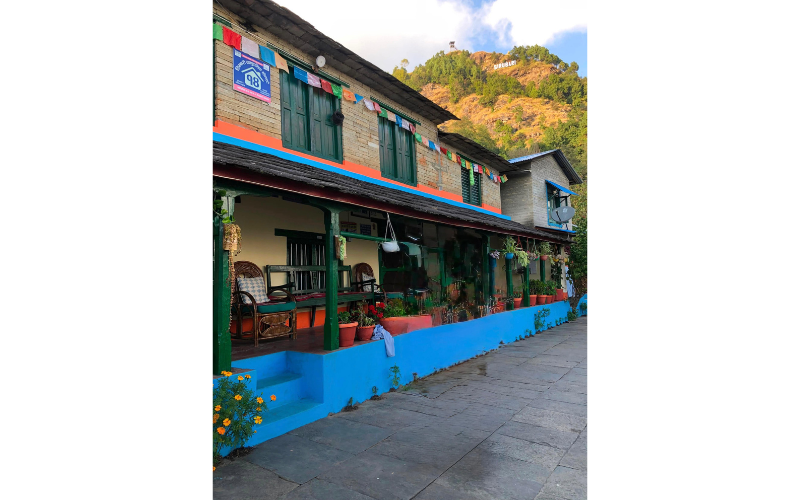
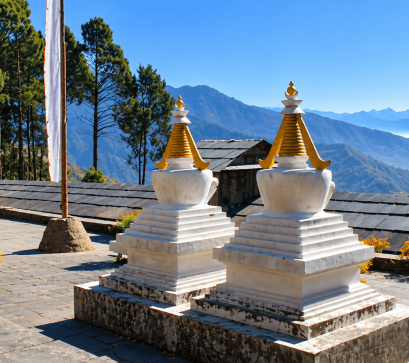
Sirubari doesn't let guests choose their host family. On arrival, visitors are welcomed with flower garlands and live panchai baja music at the village entrance, taken to the local gompa for a blessing, and then assigned – by rotation, through the village's Tourism Development and Management Committee – to a household for the duration of their stay. This isn't a formality; it's the entire point. It keeps income spread evenly across the community and keeps any one family from becoming a "tourist house" rather than a home.
Once inside, the routine is unhurried: help with the day's chores if you like, walk the stone lanes between slate-roofed houses, sit in on a conversation that needs no shared language to feel warm. Evenings bring a shared meal cooked from what the terraces produced that season, followed by Gurung cultural performances – Ghatu, Sorathi, Salaijo – danced in the courtyard by firelight.
The signature outing is the pre-dawn hike to Thumro Juro or the nearby Gorujure viewpoint (roughly 2,000–2,023 metres), a two-hour climb rewarded with a sunrise line-up of Annapurna, Dhaulagiri, Machhapuchhre, and Manaslu breaking pink over the ridgeline. Bring a headlamp; the trail leaves before first light.
Most visitors pair Sirubari with two or three nights in Pokhara, treating the village as a two-day detour rather than a standalone trip – which is exactly how it works best.
Late September through early May is considered prime season: skies are clearest for mountain views, and the terraced fields are either freshly harvested (autumn) or turning green (spring). The monsoon months of June to September bring lush hillsides but persistent cloud cover that can bury the Himalayan panorama for days at a stretch.
Homestay packages are typically arranged through the village committee or a Pokhara-based trekking agency and bundle accommodation, full board, and a cultural program into one nightly rate. Rooms are simple – clean bedding, shared or basic private toilets, solar power in most houses – and deliberately unfussy; part of Sirubari's appeal is that it has resisted turning itself into a resort. Don't expect hot showers as standard, reliable Wi-Fi, or a bar. Do expect to eat better, and more honestly, than in most Kathmandu restaurants.
Sirubari's economy still runs on a rotation system built on trust between roughly twenty host households. Booking ahead through a recognised operator or the village committee – rather than showing up unannounced – keeps that system functioning and ensures your stay is actually distributed fairly rather than dumped on whichever family happens to be free. It's a small courtesy that keeps a three-decade-old model working for the next thirty years.
For travellers weighing homestay options across Nepal, Sirubari remains the reference point: not the most remote, not the most photogenic on a spec sheet, but the place where the idea itself began – and, on quiet evenings between the terraces and the mountain line, still the one that does it best.
Picture Credits: Anjali Gyawali