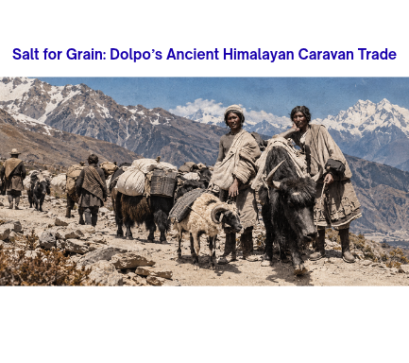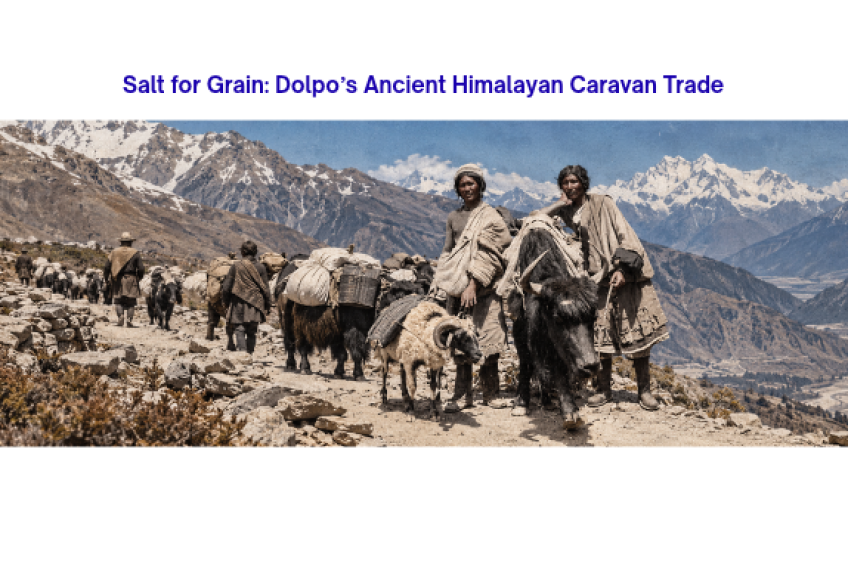
High in the rugged mountains of Dolpo, where villages cling to isolated valleys and snow-covered passes rise above 5,000 metres, salt was once more valuable than money. For centuries, local communities depended on an extraordinarFy trading tradition: exchanging Tibetan rock salt for grain from Nepal’s lower hills. Known as the Dolpo caravan trade, this seasonal journey connected two contrasting landscapes and became a lifeline for Himalayan families.
The trade emerged from geographical necessity. Tibet’s high plateau contained abundant salt deposits, particularly around its mineral-rich lakes, but its harsh climate limited agriculture. Meanwhile, Nepal’s middle hills produced rice, barley, millet, maize and wheat but lacked local salt supplies. Dolpo’s communities, positioned between these regions, became essential intermediaries.
Every trading season, caravans carrying salt, wool and other goods travelled through steep valleys, narrow trails and dangerous mountain passes. Yaks and dzos transported heavier loads, while sheep and goats carried smaller quantities along difficult routes. Some journeys crossed elevations exceeding 5,000 metres, where unpredictable snowfall and freezing temperatures threatened both traders and animals.
Unlike modern commerce, the exchange largely operated without currency. Salt was traded directly for grain, with exchange rates varying according to distance, availability and harvest conditions. In some areas, one measure of salt could secure several measures of grain. These transactions depended on trust, longstanding family partnerships and relationships maintained across generations.
For Dolpo’s isolated settlements, the caravans provided more than food. They encouraged cultural exchange, supported religious institutions and connected communities otherwise separated by formidable Himalayan terrain. Ancient trails near Shey Gompa and the Shey Phoksundo region still reflect this trading heritage.
The tradition also inspired Himalaya (Caravan), the 1999 film directed by Éric Valli. Set in Dolpo, the film portrays villagers transporting rock salt through treacherous mountains to obtain grain. It later received an Academy Award nomination for Best Foreign Language Film.
However, the trade declined significantly during the second half of the twentieth century. Political changes affecting Tibet, improved transport networks and the growing availability of inexpensive iodised salt reduced dependence on traditional caravans. Many families gradually shifted towards livestock herding, medicinal herb collection and tourism.
Today, travellers exploring Upper Dolpo can encounter historic caravan trails, remote settlements, monasteries and landscapes shaped by generations of traders. These high-altitude journeys require careful acclimatisation, suitable permits and experienced local guides.
Although large-scale salt caravans have largely disappeared, their legacy remains deeply embedded in Dolpo’s cultural identity. The ancient salt-for-grain trade was never simply about exchanging goods; it was about survival, cooperation and the enduring connection between Nepal’s Himalayan communities.