Most visitors walking between Thamel and Kathmandu Durbar Square never notice the narrow archway on Kilagal Street that leads into Itum Bahal, even though it sits only a short walk from the crowded stalls of Asan Market and Indra Chowk.
Formally called Shree Bhaskardeva Sanskarita Keshchandra Krit Paravart Mahavihara, and known locally as Keshchandra Mahavihar or Itum Baha, it is the largest traditional Newar Buddhist monastery courtyard, or bahal, in the old city, and one of the oldest intact monastic spaces still in use in Nepal.
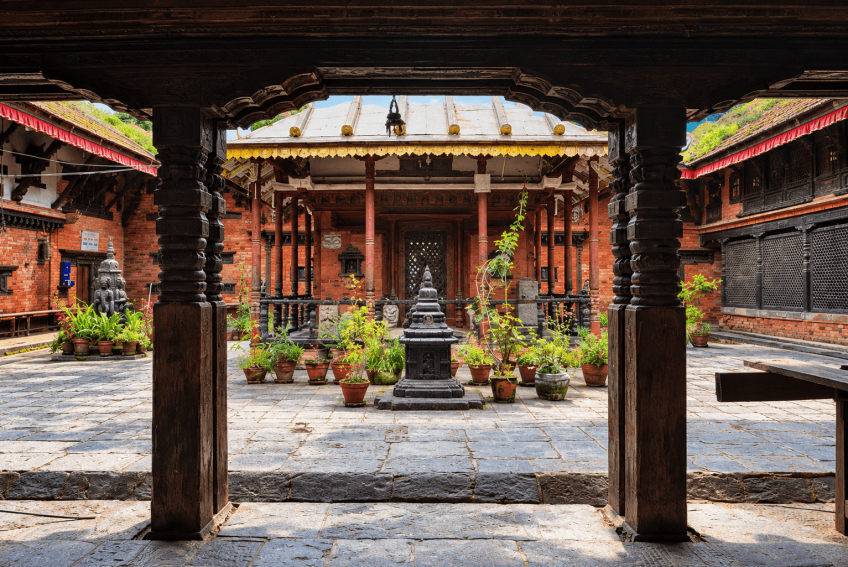
The complex is built around one large rectangular courtyard connected to seven smaller inner courtyards, called nanis, including Tara Nani, Saraswati Nani, Baku Nani, and Kayagu Nani. The main shrine structures were rebuilt around 1381 AD, though the core buildings seen today date mostly from the 13th century.
The World Monuments Fund lists it as one of only three medieval monasteries in the Kathmandu Valley that still retain their original layout. Visitors can see Malla-era woodcarvings, carved door tympanums known as toranas, terracotta-tiled paving, timber struts, and stone votive chaityas scattered through the grounds.
Itum Bahal's founding is tied to a well-known Newar legend. A wealthy but ruined gambler named Kesh Chandra is said to have fallen asleep in a forest near what is now Tundikhel, where pigeons took pity on him and turned their droppings into gold.
A demon named Guru Mapa offered to carry the gold home in exchange for a daily meal of children. To stop the killings, residents struck a deal sending Guru Mapa to live at Tundikhel in return for an annual feast of boiled rice and buffalo meat, still held every year during Holi. Four brass plaques on the courtyard's northern wall depict the story.
Tara Nani holds brass shrines to the Green, White, and Yellow Tara, including a statue of Mahashanta Shweta Tara that local lore says flew to Kathmandu from the Potala Palace in Tibet. The monastery was damaged in the 2015 earthquake but has since been fully repaired. In July 2023, the on-site Itumbaha Museum opened in partnership with the Rubin Museum of Himalayan Art, displaying more than 150 sacred artifacts and woodcarvings from the monastery's collection.
Itum Bahal is open around the clock and free to enter, though daylight hours are best for viewing the woodwork and visiting the museum. The main entrance is a narrow archway off Kilagal Street, about ten minutes on foot from Thamel; signage is minimal, so it helps to ask local shopkeepers or carry a heritage walk map.
Because it remains an active place of worship and a residential community, visitors should keep their voices down, dress modestly, and walk clockwise around the stupas and shrines rather than treating the courtyard as a photo stop.