Deep within Nepal’s Himalayan foothills, where towering cliffs rise above dense forests and winding rivers, an extraordinary tradition continues to thrive. Honey hunting, one of Nepal’s most fascinating indigenous practices, involves collecting wild honey from enormous beehives hanging along steep rock faces. Practised for generations by communities including the Gurung, Magar, and Kulung, this remarkable tradition represents courage, cooperation, and a deep connection with nature.
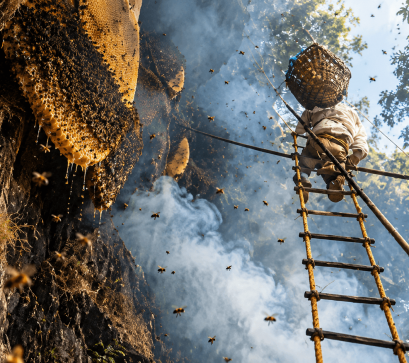
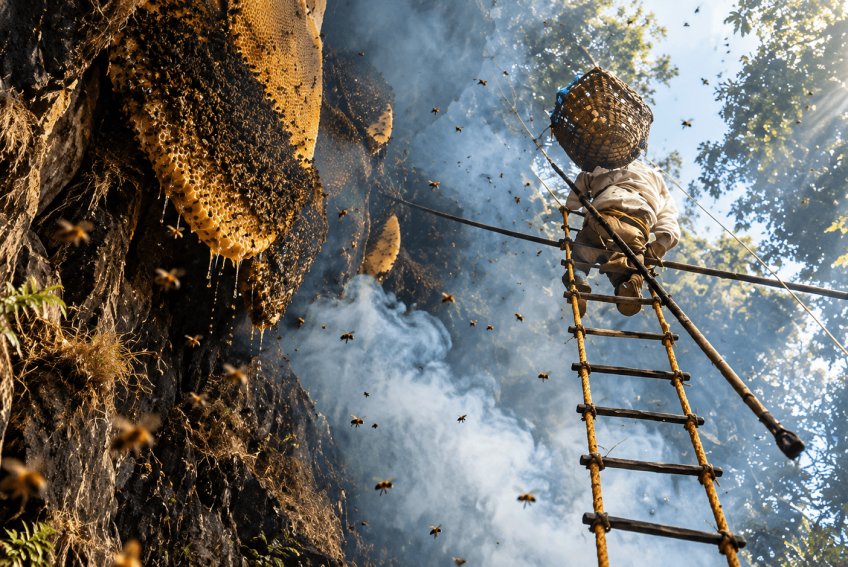
Honey hunting is not for the faint-hearted. Armed with handmade bamboo rope ladders, long wooden poles, and woven baskets, skilled hunters descend towering cliffs to reach the massive honeycombs of Apis laboriosa, the world's largest honeybee.
Before the harvest begins, villagers gather to perform traditional rituals, offering prayers to forest spirits and seeking blessings for a safe expedition. As smoke rises from fires below the cliffs, the hunters carefully approach the hives, surrounded by thousands of buzzing bees.
Suspended high above the ground, they cut sections of honeycomb and lower them into baskets while fellow villagers manage the ropes below. Every movement demands exceptional balance, experience, and teamwork.
One of the most fascinating aspects of this tradition is the collection of mad honey, a rare variety produced when Himalayan giant honeybees gather nectar from certain rhododendron flowers.
Known for its reddish colour and unusual properties, mad honey contains grayanotoxins, naturally occurring compounds that can cause dizziness, nausea, and potentially serious poisoning. Although traditionally valued for medicinal purposes, its consumption carries significant health risks.
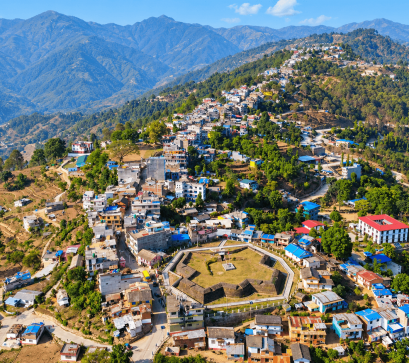
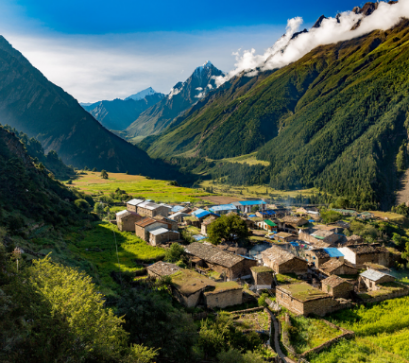
Honey hunting is particularly associated with Nepal’s Lamjung, Kaski, Gorkha, and Rolpa districts. Villages such as Bhujung in Lamjung and Jelbang in Rolpa preserve this remarkable practice through generations of inherited knowledge.
The harvesting season generally falls during spring (April–May) and autumn (October–November), although the exact timing varies depending on weather conditions and bee activity.
For travellers, witnessing a traditional honey hunt offers more than an adventurous spectacle. It provides an opportunity to experience rural lifestyles, community rituals, traditional craftsmanship, and Nepal’s extraordinary natural landscapes.
Despite its cultural significance, traditional honey hunting faces growing challenges from deforestation, climate change, habitat disruption, and changing lifestyles.
Responsible tourism and community-led conservation can help protect both the Himalayan giant honeybee and the ancestral knowledge of local hunters.
Ultimately, honey hunting is much more than collecting golden nectar. It is a powerful expression of human courage, cultural identity, and harmony with nature, preserving a remarkable piece of Nepal’s living heritage for future generations.