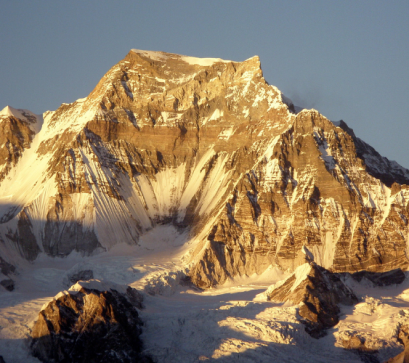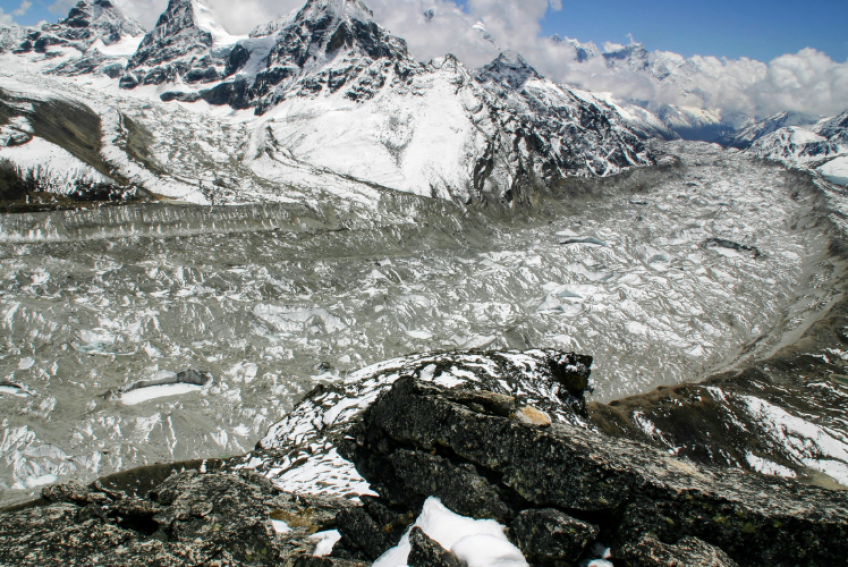
Flowing through the high valleys of Sagarmatha National Park, the Ngozumpa Glacier is the longest glacier in Nepal, stretching approximately 36 kilometres. It originates from the slopes of Cho Oyu (8,188m), the world’s sixth-highest mountain, and descends south through the Gokyo Valley.
Often described as a vast “river of ice”, Ngozumpa is also regarded as one of the longest glaciers in the Himalaya, though classifications vary across the broader mountain system.
A Debris-Covered Glacier Landscape
Unlike the pristine white glaciers often imagined, Ngozumpa’s lower sections are heavily covered in debris: layers of rock, sand, and sediment that insulate the ice beneath. Large portions of the glacier are mantled in this material, giving it a rugged, lunar-like appearance.
The glacier flows slowly under its own weight, with movement becoming minimal in its lower reaches, where sections are considered nearly stagnant.
Supraglacial Lakes and Dynamic Ice
Meltwater pools, known as supraglacial lakes dot the glacier’s surface, particularly in its lower section. These lakes form as the glacier thins and melts, creating striking contrasts of grey debris and turquoise water.
At the terminus, a growing moraine-dammed lake, commonly referred to as Spillway Lake has been observed. Scientific observations suggest it could expand significantly over time, reflecting ongoing glacial change.
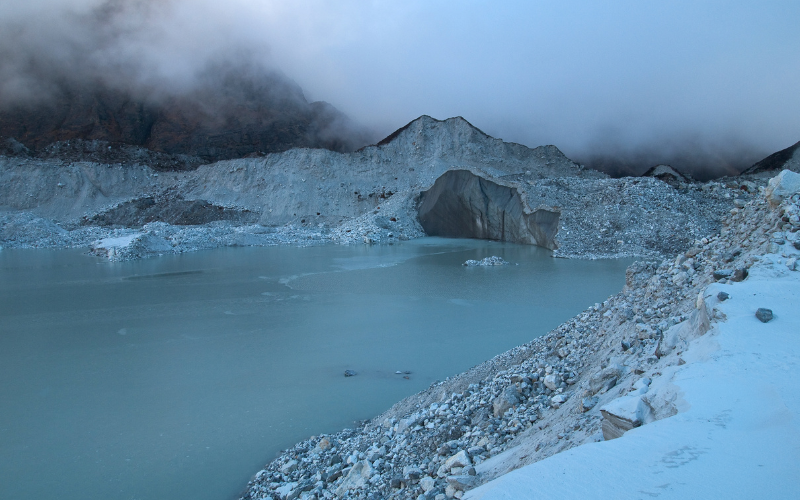
The Ngozumpa Glacier is widely studied as an indicator of Himalayan climate change. Research and satellite observations show clear signs of:
These changes are consistent with broader warming trends across the Himalaya, where glaciers are increasingly losing mass and forming unstable lake systems.
The expansion of proglacial lakes raises concerns over Glacial Lake Outburst Floods (GLOFs): sudden releases of water that could impact downstream communities.
On the Gokyo Trail
The glacier lies between Gokyo and Thangnak, forming a dramatic section of the route towards Cho La Pass. Trekkers crossing this terrain encounter uneven, rock-covered ice and a constantly shifting landscape.
Gokyo Ri: The Ultimate Viewpoint
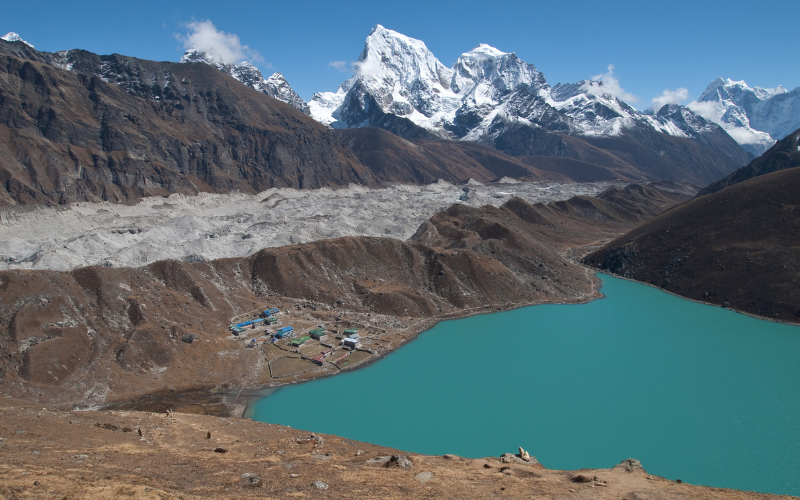
From the summit of Gokyo Ri (5,357m), trekkers are rewarded with one of the finest panoramas in Nepal. The viewpoint overlooks the full expanse of the glacier alongside the Gokyo Lakes.
On a clear day, four of the world’s highest peaks are visible:
Winter treks are possible but cold, while the monsoon season brings limited visibility and slippery trails.
Typical route:
Proper acclimatisation is essential due to elevations exceeding 4,700 metres.
Beyond its scale and visual drama, the Ngozumpa Glacier represents a living record of environmental change in the Himalaya. Its shifting ice, expanding lakes, and evolving terrain offer both a powerful trekking experience and a reminder of the fragile balance shaping Nepal’s high mountain ecosystems.
Also Read