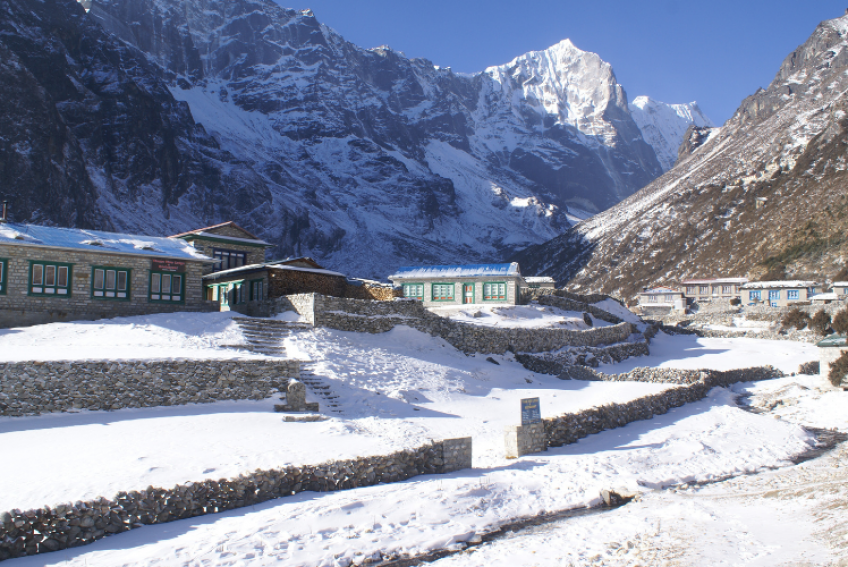
If you stand at the trail junction just west of Namche Bazaar, you face a choice most Everest Base Camp trekkers never make. To the right, the path climbs towards Tengboche, Dingboche, and the glacier-bound crowds beyond. To the left, the trail to Thame Village slips quietly into a lesser-known valley, following the Bhote Koshi River towards the Tibetan frontier.
Within thirty minutes, the crowds dissolve. Tea houses thin out. And the Khumbu that emerges feels older, quieter, and closer to its origins.
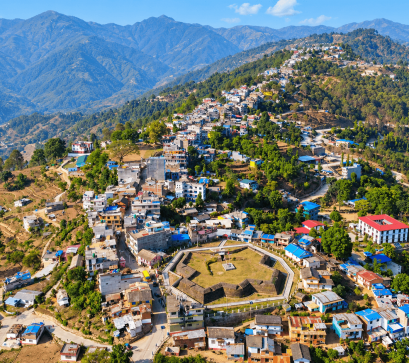
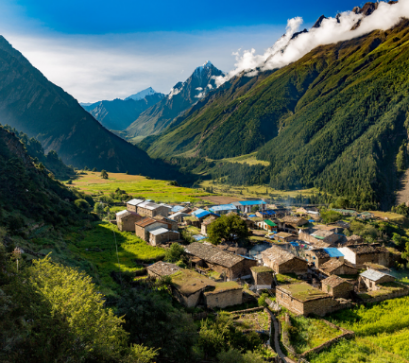
Thame (pronounced tah-may) sits at approximately 3,800 metres (12,500 feet) in the upper Bhote Koshi valley, a three-to-four-hour walk from Namche Bazaar. Removed from the main Lukla–Everest corridor, it receives only a fraction of the footfall, yet offers something increasingly rare in the region: a Sherpa village shaped by heritage rather than tourism.
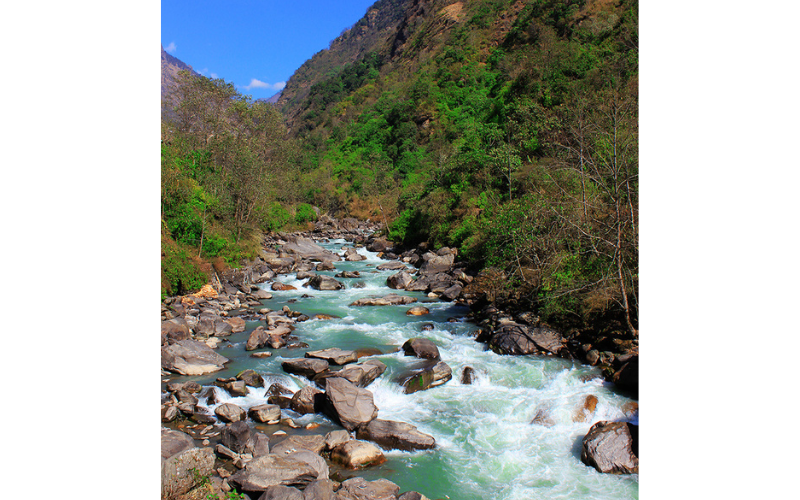
Thame lies in Nepal’s Solukhumbu District, within Sagarmatha National Park, the protected Himalayan landscape that includes Mount Everest.
The village sits along the Bhote Koshi River literally “River from Tibet”, which flows south from the historic Nangpa La Pass on the Tibetan border. Rising to 5,716 metres (18,753 feet), this high mountain pass once served as a vital trans-Himalayan trade route.
For centuries, Sherpa traders crossed Nangpa La carrying salt, wool, grain, and religious artefacts between Tibet and the Khumbu. While the route is now largely restricted and primarily used by mountaineering expeditions approaching Cho Oyu, its presence still defines the valley’s identity.
From above Thame, the pass appears as a distant saddle in the ridge: a quiet reminder of the Sherpa people’s migration and enduring cultural ties to Tibet.
Thame is more than a scenic Himalayan village. It holds a remarkable place in mountaineering history and Sherpa heritage.
Tenzing Norgay, who, alongside Edmund Hillary, first summited Everest in 1953 is closely associated with Thame, where he spent much of his childhood.
While some historical accounts trace his birthplace to Tibet’s Kharta Valley, Thame is where he grew up; herding yaks, attending a monastery school, and beginning a journey that would lead to the world’s highest summit.
His family home still stands in the village. Unmarked and indistinguishable from neighbouring houses, it remains a powerful symbol: one of the greatest figures in mountaineering history emerged from a life of striking simplicity.
Few Himalayan settlements have contributed as significantly to mountaineering as Thame and its surrounding valley. Among its notable figures:
This extraordinary concentration of high-altitude expertise reflects generations of adaptation to life in extreme terrain.
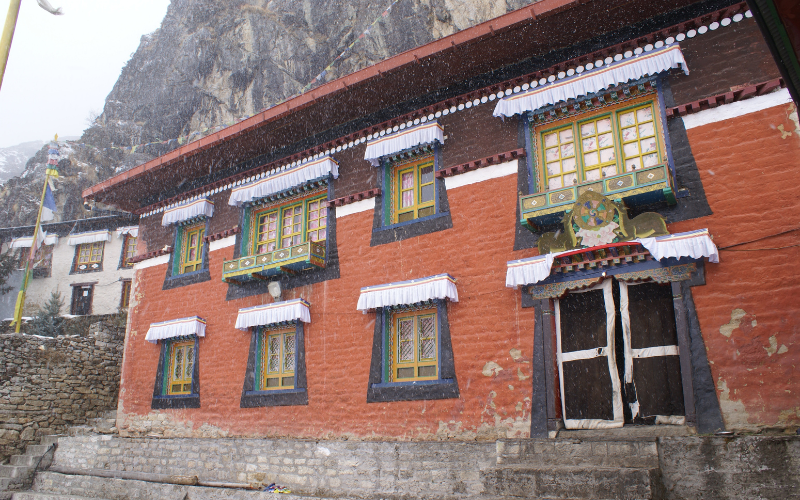
Perched above the village at around 3,960 metres, Thame Gompa (Dechen Chokhorling Monastery) is among the oldest monasteries in the Khumbu.
History and Significance
Founded in the 16th century, the monastery belongs to the Nyingma tradition, the oldest school of Tibetan Buddhism linked to Guru Rinpoche (Padmasambhava).
Inside, the prayer hall holds ancient murals, statues, and softly flickering butter lamps, while the surrounding silence gives the space an intimacy rarely found in more visited monasteries like Tengboche.
Mani Rimdu Festival
Thame hosts its own Mani Rimdu festival, typically held in spring (often May), based on the Tibetan lunar calendar.
The celebration includes:
Smaller and less crowded than Tengboche’s version, it offers a more community-rooted cultural experience.
Visiting the Monastery
A 30-40 minute uphill walk from the village leads to the monastery.
Visitor etiquette:
A Better Acclimatisation Day from Namche
Instead of the standard hotel hike, the walk to Thame offers equal acclimatisation benefit with far greater cultural depth.
The elevation gain is similar, but the experience is entirely different.
Trail Overview
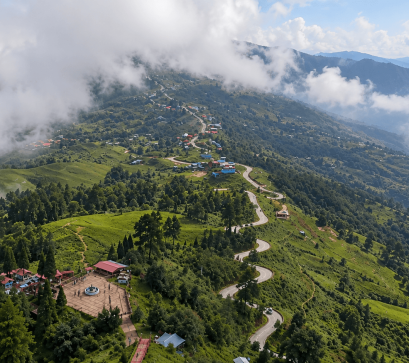
The trail from Namche Bazaar (3,440 m) begins with a gentle ascent out of town before levelling into a scenic contour along the valley. The first stop is Thamo (3,490 m), a small settlement known for its hillside nunnery, followed by the quieter hamlet of Thomde (around 3,600 m). From here, the path gradually leads to Thame (approximately 3,800 m), the final destination, where the valley opens into a peaceful landscape framed by traditional Sherpa homes and mountain views.
Compared to the main EBC trail, expect:
Day 1: Namche - Thame (3-4 hrs)
Day 2: Thame - Namche (2.5-3 hrs)
For trekkers adding Thame to a standard EBC itinerary:
This adds one night to the standard itinerary (the overnight in Thame) but does not add extra days if planned properly. Staying overnight allows you to experience the valley’s rare stillness at dusk and dawn.
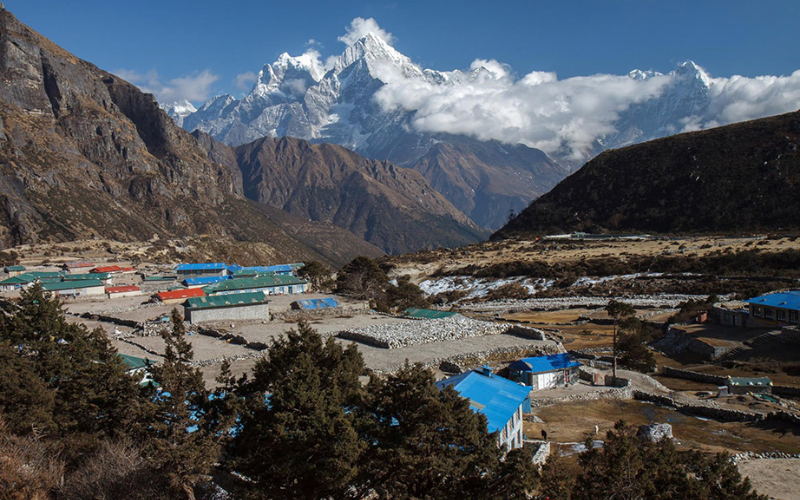
Autumn (October-November) offers clear skies and peak trekking conditions, while spring (March–May) brings warmer weather and cultural festivals. Winter (December-February) is cold but quiet and uncrowded, whereas the monsoon months (June-August) bring rain and low visibility, making travel less ideal.
Thame offers something the main Everest trail increasingly cannot: perspective.
It is not untouched, but it is not defined by tourism. Life here continues because it always has, shaped by geography, faith, and history rather than itineraries.
To walk to Thame is to understand that the Khumbu is larger than its busiest trail, and that its stories begin long before Everest came into view.
Sometimes, the most meaningful journeys in the Himalayas begin with a simple decision: to turn left instead of right.
PC: Himalayan Wonders, Wikimedia Commons
Also Read