

 Source::AP news
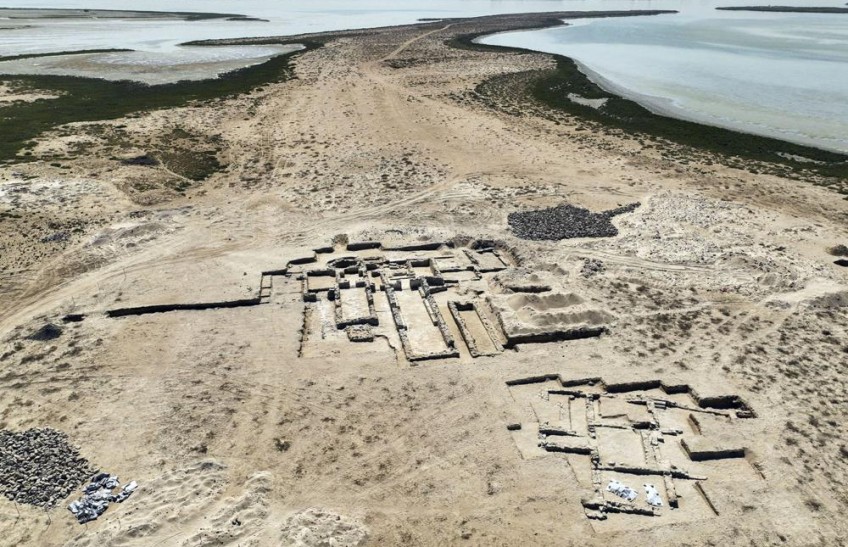
The monastery on Siniyah Island, part of the sand-dune sheikhdom of Umm al-Quwain, sheds new light on the history of early Christianity along the shores of the Persian Gulf. It marks the second such monastery found in the Emirates, dating back as many as 1,400 years.
The two monasteries became lost to history in the sands of time as scholars believe Christians slowly converted to Islam as that faith grew more prevalent in the region. Carbon dating of samples found in the monastery’s foundation dates between 534 and 656. Islam’s Prophet Muhammad was born around 570 and died in 632 after conquering Mecca in present-day Saudi Arabia.
The monastery on Siniyah Island floor plan suggests early Christian worshippers prayed within a single-aisle church at the monastery. Rooms within appear to hold a baptismal font, as well as an oven for baking bread or wafers for communion rites. A nave also likely held an altar and an installation for communion wine.
The site saw a visit from Noura bint Mohammed al-Kaabi, the country’s culture, and youth minister, as well as Sheikh Majid bin Saud Al Mualla, the chairman of the Umm al-Quwain’s Tourism and Archaeology Department and a son of the emirate’s ruler.
The UAE’s Culture Ministry has sponsored the dig in part, which continues at the site. Just hundreds of meters (yards) away from the church, a collection of buildings that archaeologists believe belongs to a pre-Islamic village sit.
Historians say early churches and monasteries spread along the Persian Gulf to the coasts of present-day Oman and all the way to India. Archaeologists have found other similar churches and monasteries in Bahrain, Iraq, Iran, Kuwait, and Saudi Arabia.
Today, the area near the marshland is more known for the low-cost liquor store at the emirate’s Barracuda Beach Resort._AP news
Also Read
